Preview 1 of 4
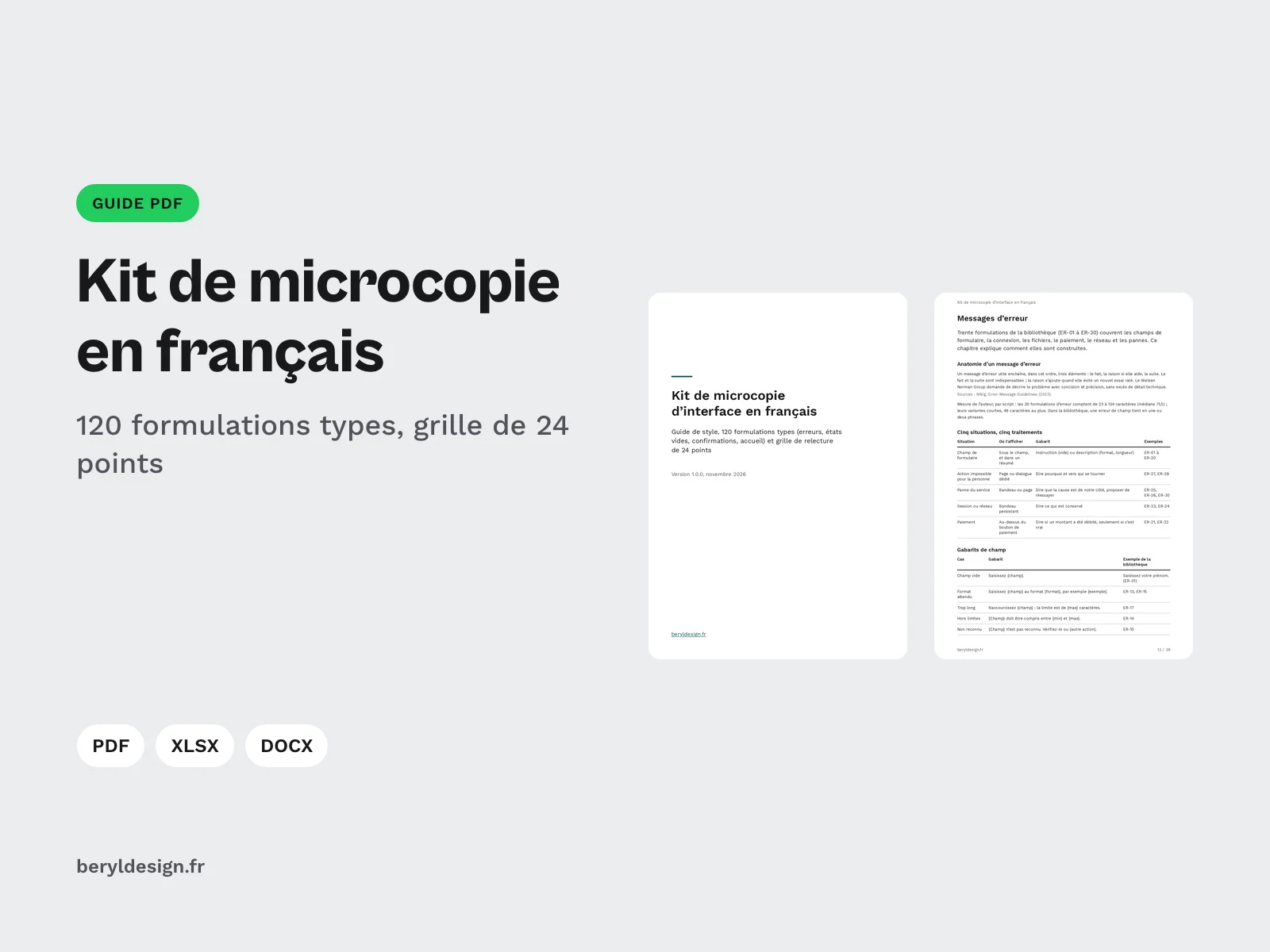
French UI microcopy kit: style guide, 120 ready phrasings (errors, empty states, confirmations, onboarding) and review grid
A style guide, 120 phrasings and a 24-point review grid to write the error, empty state, confirmation and onboarding texts of French interfaces. In French.
Overview
Description
The kit is written in French, for interfaces written in French. Every file is in French: the guide, the phrasings, the review grid, the style guide template and the example. It is not a translation aid and does not cover English microcopy. It is meant for designers, developers who write the texts of their own product, people new to microcopy and freelancers asked to review the texts of an app in French. It gives you rules to choose a register and write buttons, French typography applied to screens, a library of phrasings ready to adapt, a grid to review each text on its real screen and a style guide template to record these decisions in your team.
The kit supports writing and reviewing; it guarantees neither that your texts are understood nor any compliance. An expert review does not replace a test with your audience: only a test shows whether the words you chose are understood. The kit gives no legal advice: legal notices, consents and terms of sale need a legal review.
Specifications
| Template phrasings | 120 in 4 families, 30 per family |
|---|---|
| Failure patterns | 14 |
| Review grid | 24 items in 6 groups |
| Style guide template | 12 parts |
| Guide | 38-page PDF |
| Filled-in example | 7 pages |
| Formats | tagged A4 PDF, XLSX, UTF-8 CSV, Markdown, DOCX |
| License | commercial (page in French) |
| Version | 1.0.0 of November 11, 2026 |
Contents
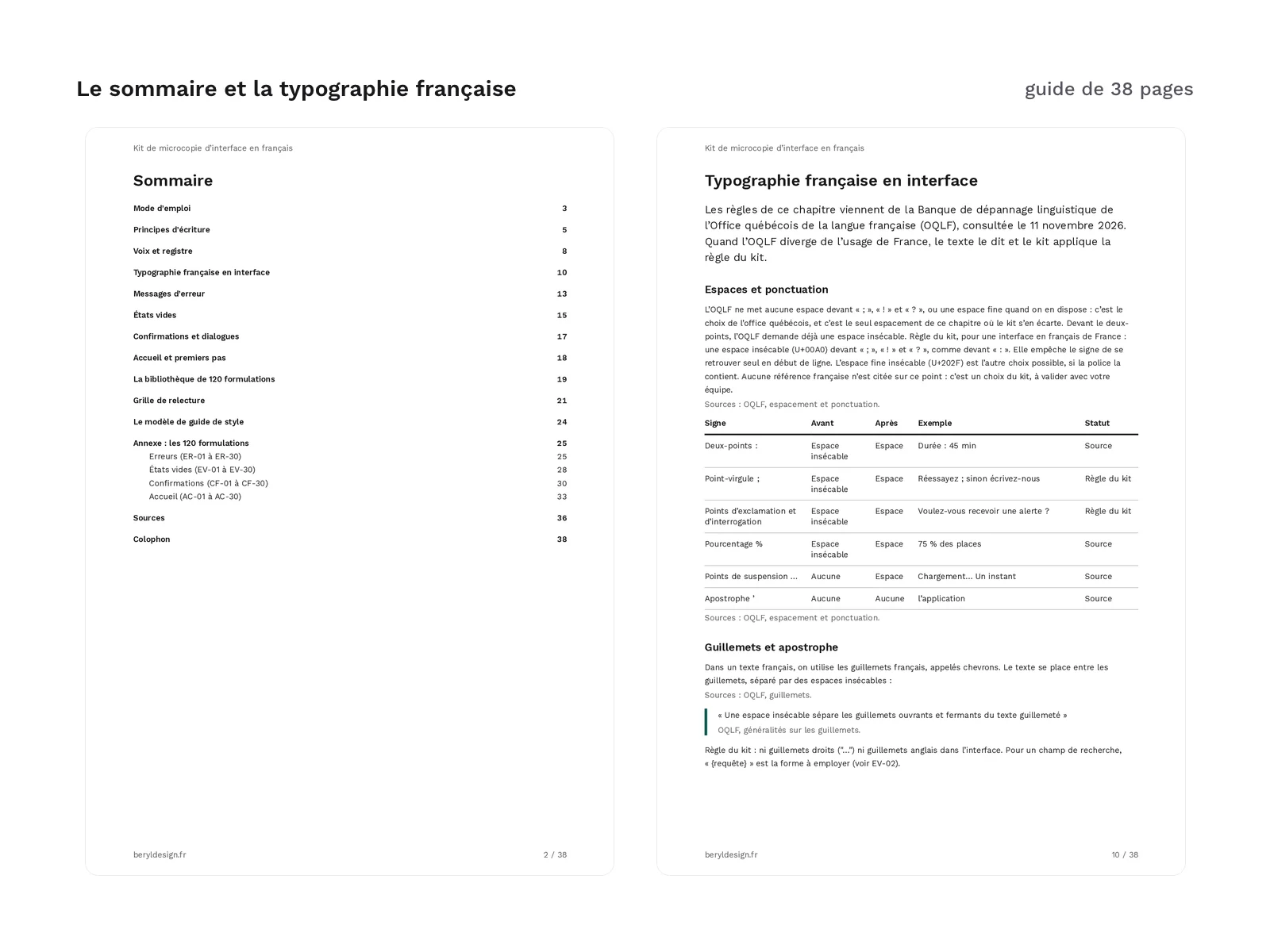
- A 38-page PDF guide: instructions, writing principles, voice and register, French typography in interfaces, one chapter per family of texts (error messages, empty states, confirmations and dialogs, onboarding and first steps), an introduction to the library, the review grid, the style guide template, an appendix with the phrasings for printing, the sources and the colophon. The table of contents and the bookmarks lead to each part. Each rule states its status: a claim taken from a dated source, a kit rule (the author’s choice, to discuss in your team) or the author’s measurement.
- French typography applied to screens: non-breaking space before the colon, the semicolon, the exclamation and question marks, French quotation marks (« »), the typographic apostrophe, accented capitals, and how to write numbers, dates, times, durations and amounts, each with the form to write and the form to avoid.
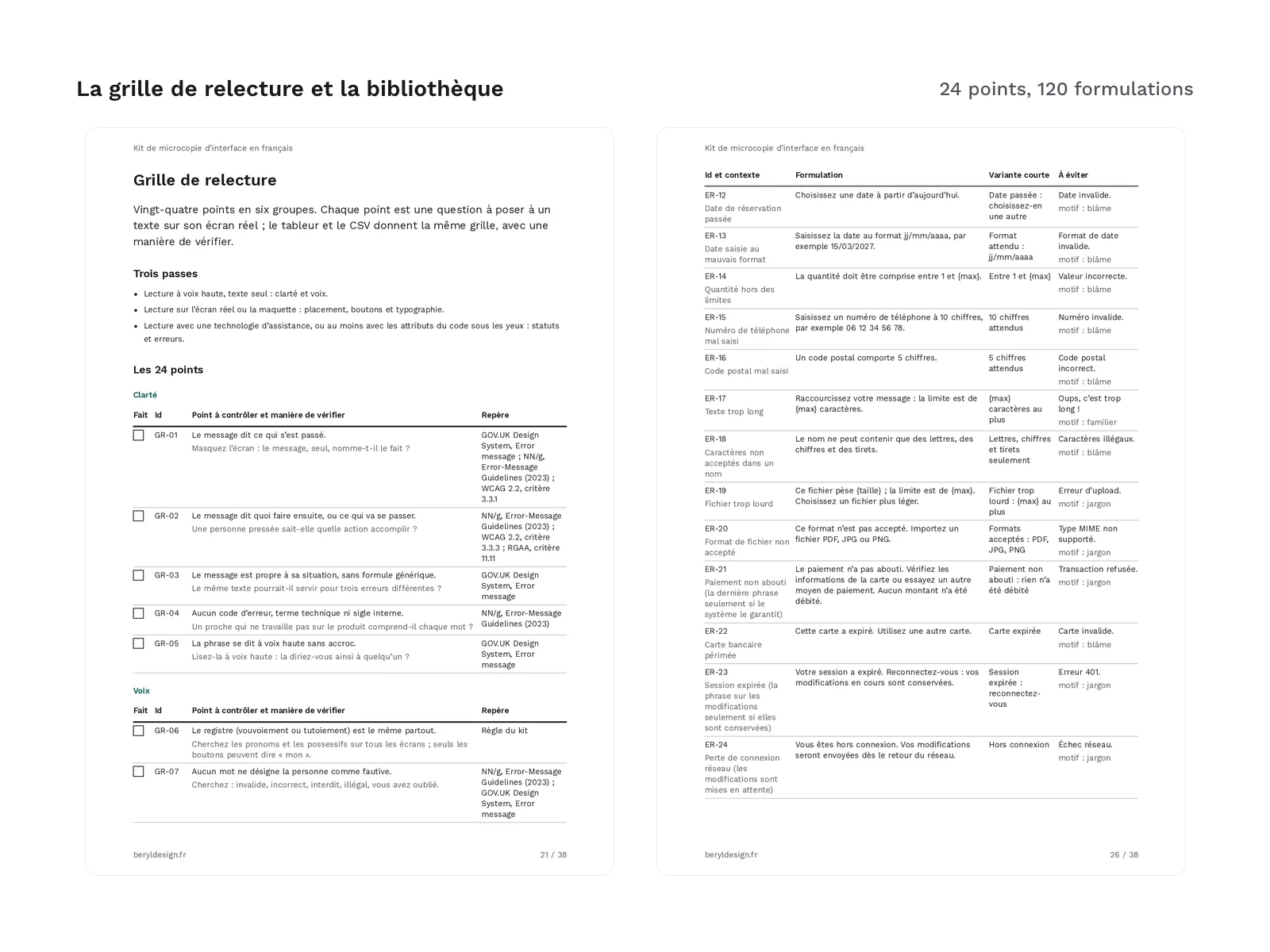
- 120 ready phrasings, 30 per family: errors, empty states, confirmations, onboarding. Each row gives the display context, the full phrasing with its buttons, a short variant for tight spaces, a common phrasing to avoid, the reason it fails and the length in characters of both versions. Variables sit in braces ({prénom}, {date}, {montant}…) and buttons in square brackets.
- 14 failure reasons to name what is wrong with a text, given in French in the files: vague, froid (cold), jargon, blâme (blame), ambigu (ambiguous), familier (too casual), bavard (wordy), impasse (dead end), trompeur (misleading), culpabilisant (guilt-tripping), genré (gendered), humour, divulgue (discloses), urgence (false urgency).
- A review grid of 24 points in 6 groups: clarity, voice, buttons, links and decisions, states, statuses and permissions, placement and timing, French typography. Each point is a question to ask of a text on its screen, with a way to check it and its reference (a source or a kit rule). Each issue gets one of 3 severities (Haute, Moyenne, Basse: high, medium, low) and a status (Conforme, À corriger, Non applicable, Non évalué: compliant, to fix, not applicable, not evaluated).
- A spreadsheet (.xlsx) with the tabs Mode d’emploi (instructions), Formulations (phrasings), Grille de relecture (review grid), Relecture (review, blank) and Exemple (example). Status and severity are picked from a list, the header row stays visible as you scroll, and a length limit you enter shows which variants fit your component.
- The phrasings and the grid as CSV, to import them into another tool.
- A style guide template in 12 parts, in Markdown and DOCX: context and use, voice and register, vocabulary, typography and formats, buttons and labels, error messages, empty states, confirmations and dialogs, onboarding and first steps, accessibility of messages, review and updates, appendices. The fields to complete are marked “[À remplir : …]” (to fill in).
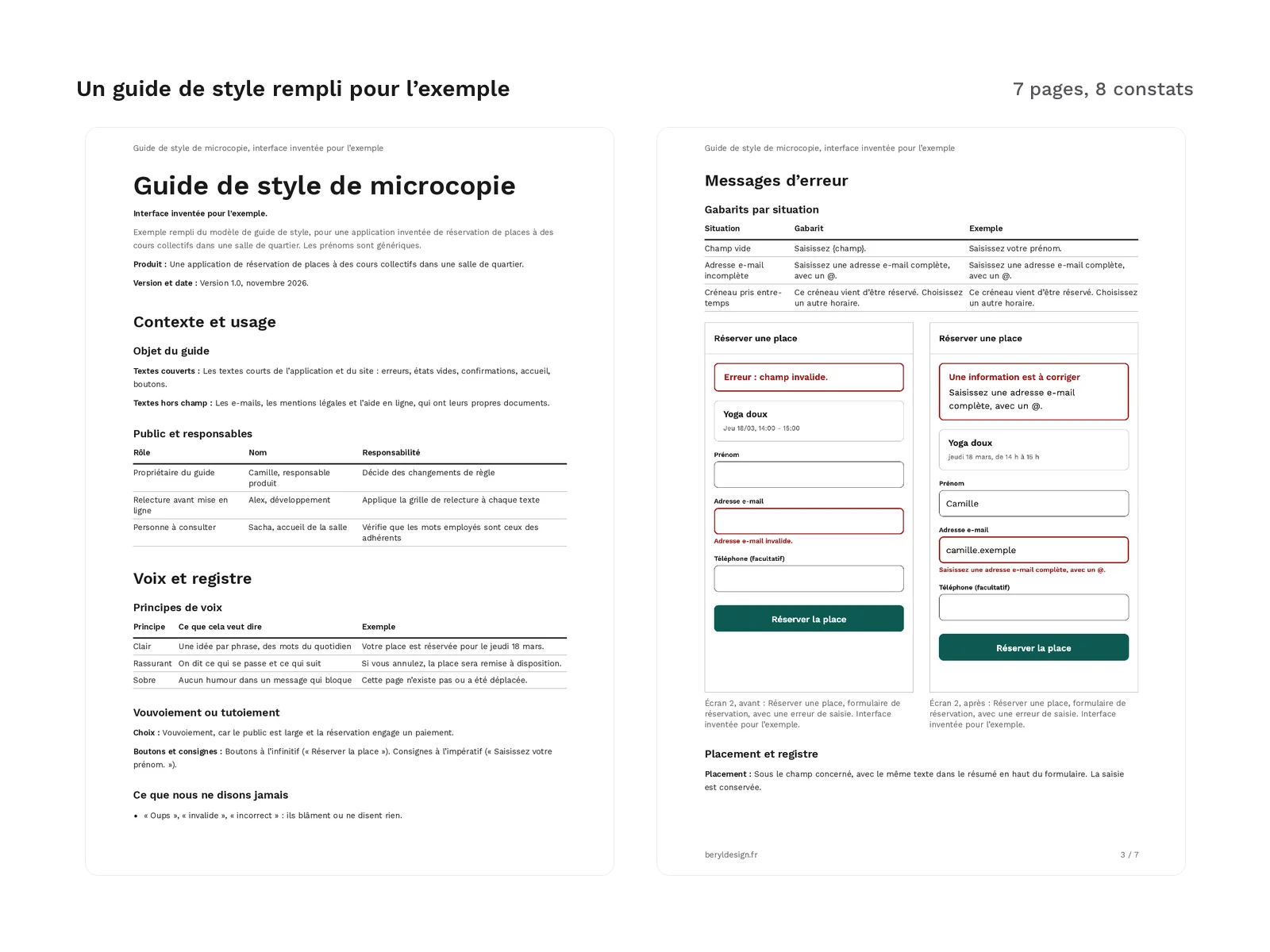
- A 7-page filled example (PDF): the template applied to an invented interface, an app to book places in group classes, with 4 screens before and after review and 8 findings linked to the grid’s points. No screenshot of a real service; first names are generic.
Examples from the library
Copied as they appear in the kit (in French), with the common phrasing the kit advises against and the reason it fails:
- Adresse e-mail sans @ (Erreurs, errors): « Saisissez une adresse e-mail complète, avec un @. » To avoid: « Adresse e-mail invalide. » Reason: blâme (blame).
- Liste vide au premier usage (projets) (États vides, empty states): « Vous n’avez pas encore de projet. Créez-en un : il s’affichera ici. » To avoid: « Aucune donnée. » Reason: froid (cold).
- Quitter un formulaire modifié (Confirmations): « Quitter sans enregistrer ? Vos modifications seront perdues. [Quitter sans enregistrer] [Continuer la modification] » To avoid: « Voulez-vous vraiment quitter ? [OK] [Annuler] » Reason: ambigu (ambiguous).
Kit files:
guide-microcopie.pdf
bibliotheque/formulations.xlsx
bibliotheque/formulations.csv
bibliotheque/grille-relecture.csv
modeles/guide-de-style.md
modeles/guide-de-style.docx
exemple/guide-style-exemple.pdf
Sources
Each attributed rule names its source at the foot of the paragraph, and the guide’s Sources page gives its address: the “Error message” component of the GOV.UK Design System, the Nielsen Norman Group’s guidelines on error messages and empty states, the W3C’s WCAG, the RGAA (the French accessibility standard) and the Banque de dépannage linguistique of the Office québécois de la langue française, all consulted on 11 November 2026. Some of these sources are in English: the guide carries their advice over into French. Quotations are short and attributed; the rest is written by the kit’s author.
Production and AI
The texts of the guide, the phrasings, the grid, the template and the example, as well as the layout scripts, were written with an AI assistant, then reviewed and checked: each reference verified against its source, PDFs tagged and tested, figures recounted by script. No image was made by an image generator: the example’s screenshots are taken from screens written for the purpose.
Formats and compatibility
- Tagged A4 PDF (guide and example): real text you can select and copy, structured headings, bookmarks, live links, language declared as French. The PDFs open in any PDF reader and print on A4.
- XLSX: the spreadsheet opens in common spreadsheet apps; the “Dans la limite” (within the limit) column recalculates as soon as you change the length limit.
- CSV UTF-8: with BOM and semicolon-separated, it opens directly in a spreadsheet set to French; columns
id,famille,contexte,formulation,variante courte,à éviter,motif,longueurandlongueur courtefor the phrasings,id,groupe,point,comment vérifierandrepèrefor the grid (headers in French). - Markdown: the style guide template can be read and completed in any text editor.
- DOCX: the same template for a word processor, with its heading styles and French as the language, with no font imposed: it takes your document’s font.
- Font: the PDFs are set in Work Sans, under the SIL Open Font License 1.1, embedded as a subset.
Good to know before you buy:
- The whole kit is in French and serves interfaces written in French. Its phrasings address the reader with “vous”, the formal register. For an interface that uses “tu”, the guide explains how to rewrite a sentence: buttons, in the infinitive, stay the same.
- The reference French is that of France. The typography rules it cites come from a Quebec office: the guide flags each difference with usage in France and states the rule it keeps.
- The PDFs are tagged (headings, bookmarks, real text, links), but the kit does not claim conformance with the PDF/UA standard. To hand over an accessible document, start from the DOCX or Markdown template.
- The kit takes up the RGAA and WCAG criteria that bear on texts; it does not cover the full accessibility of an interface, and the full standard remains to be consulted.
License
The kit is sold under the commercial license (terms in French): you may use the phrasings in your own products and in your clients’ products, and hand your clients a style guide based on the template, but you may not resell or redistribute the kit, in whole or in part.
Further reading
- The Fundamental Principles of UI Design
- Designing for Accessibility
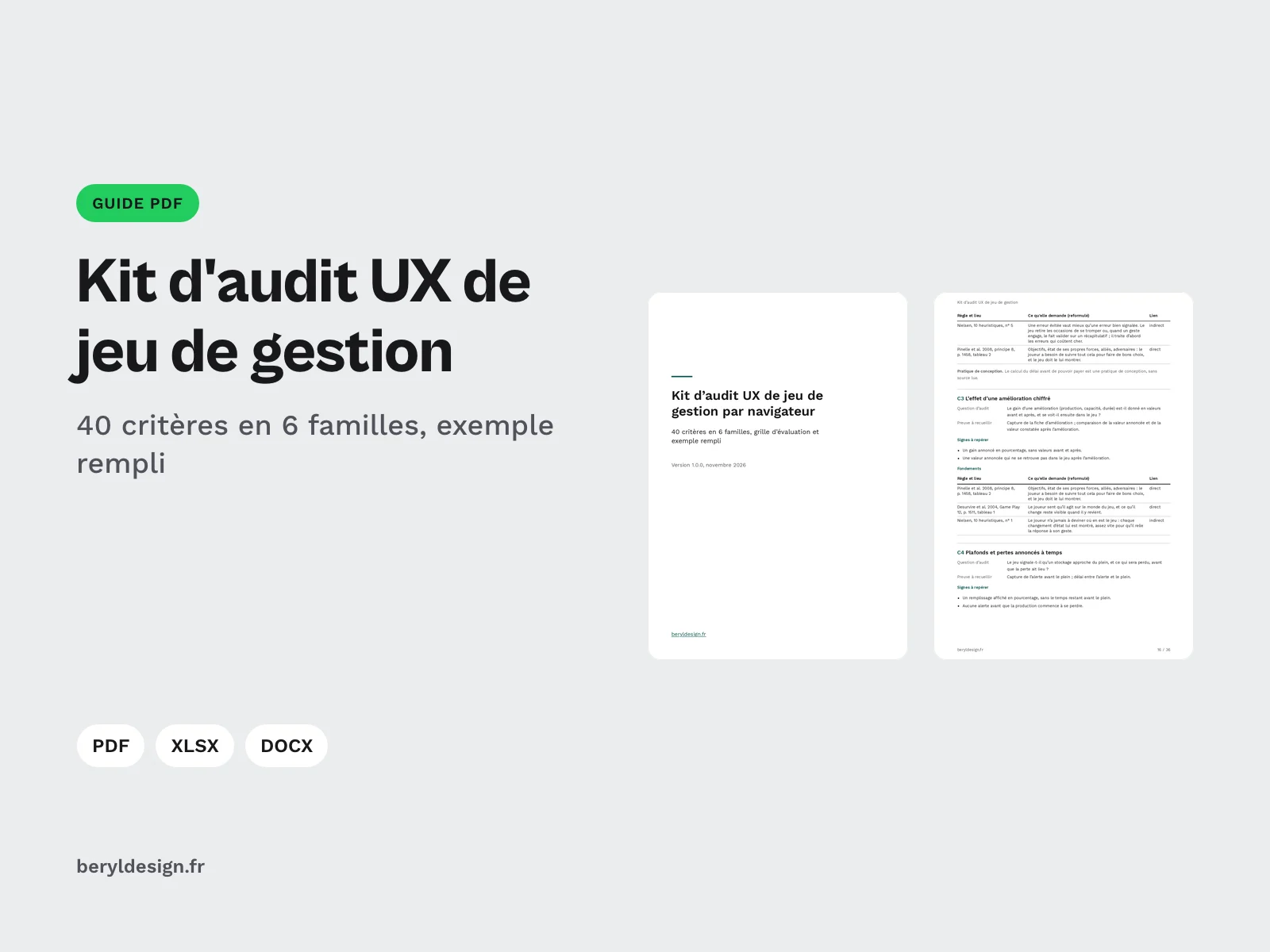
- French UX audit kit: its “empty states and errors” checklist spots what to fix; this kit gives the words to fix it.
- French user research kit: to check in a test with your audience that the words you chose are understood.
Version history
1.0.0 (11 November 2026): first version.