Preview 1 of 4
French user research kit: 8 templates (interview, usability test, consent, screener, persona, empathy map, synthesis, report) and PDF guide
8 templates to run user research in French: interview, usability test, consent, screener, persona, empathy map, synthesis and report, plus a PDF guide.
Overview
Description
The kit is written in French. Every file is in French: the guide, the templates, the spreadsheet and the example. It is meant for UX and UI designers, freelancers and small product teams who run a small qualitative study in French: a few interviews or a few usability tests, run by one or two people, to inform a design decision. It takes you from scoping to the report, with a guide that sets out the method in 6 steps (scope, recruit, prepare, run, synthesize, report back), ready-to-fill templates for each step and an example study filled in from start to finish.
It complements an expert review without replacing it: an expert review judges an interface against usability principles, without its users; a study shows what people actually go through. The kit does not measure: a study with few participants reveals problems and their causes, not percentages that hold for a whole population. It does not cover large-scale surveys, audience measurement or accessibility evaluation.
Specifications
| Guide | 17-page PDF |
|---|---|
| Templates | 8, including 7 in DOCX |
| Printable canvases | 2 |
| Sample study | 9 pages |
| Formats | tagged A4 PDF, landscape A4 PDF, DOCX, Markdown, XLSX, UTF-8 CSV |
| License | commercial (page in French) |
| Version | 1.0.0 of November 11, 2026 |
Contents
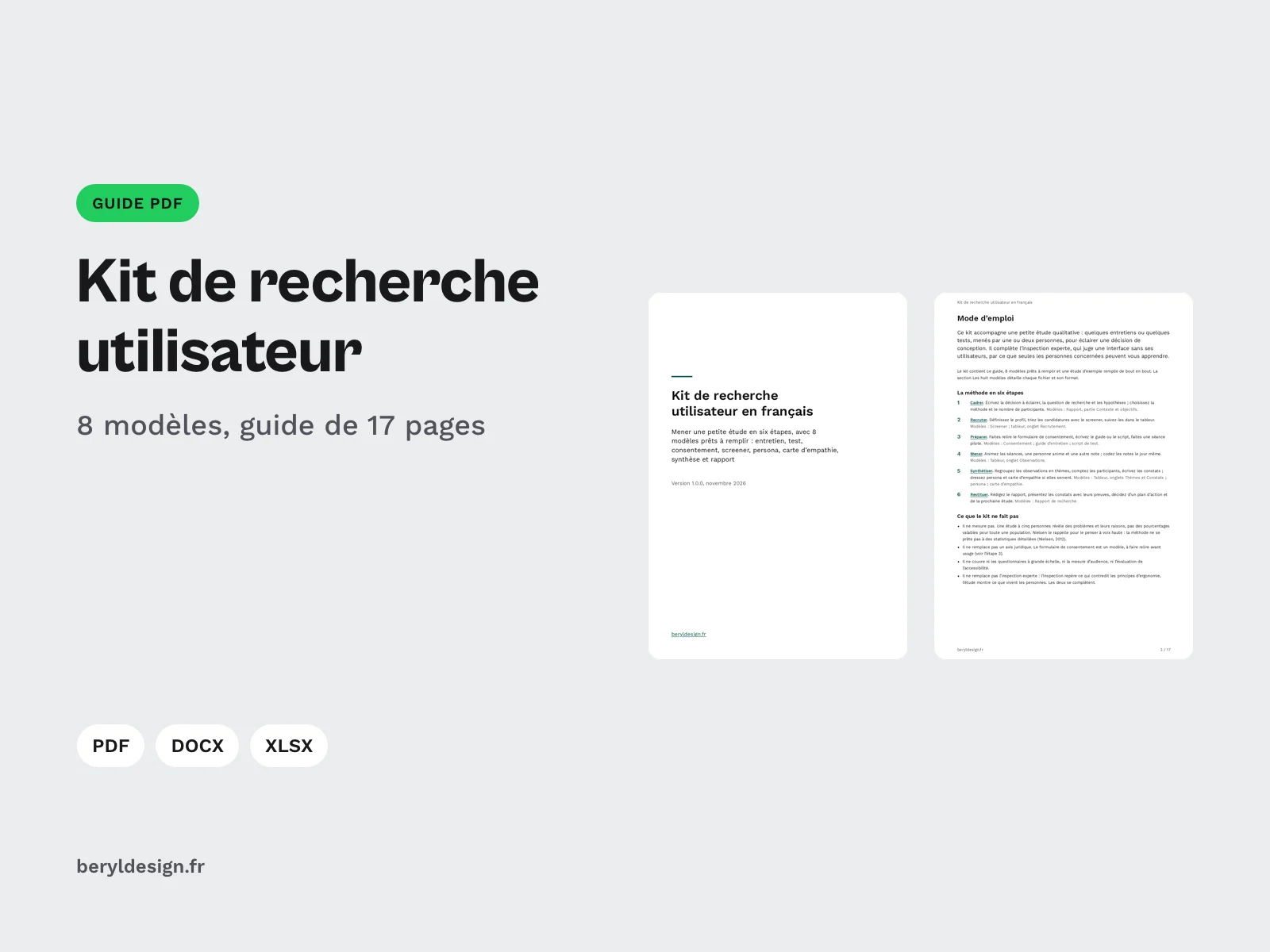
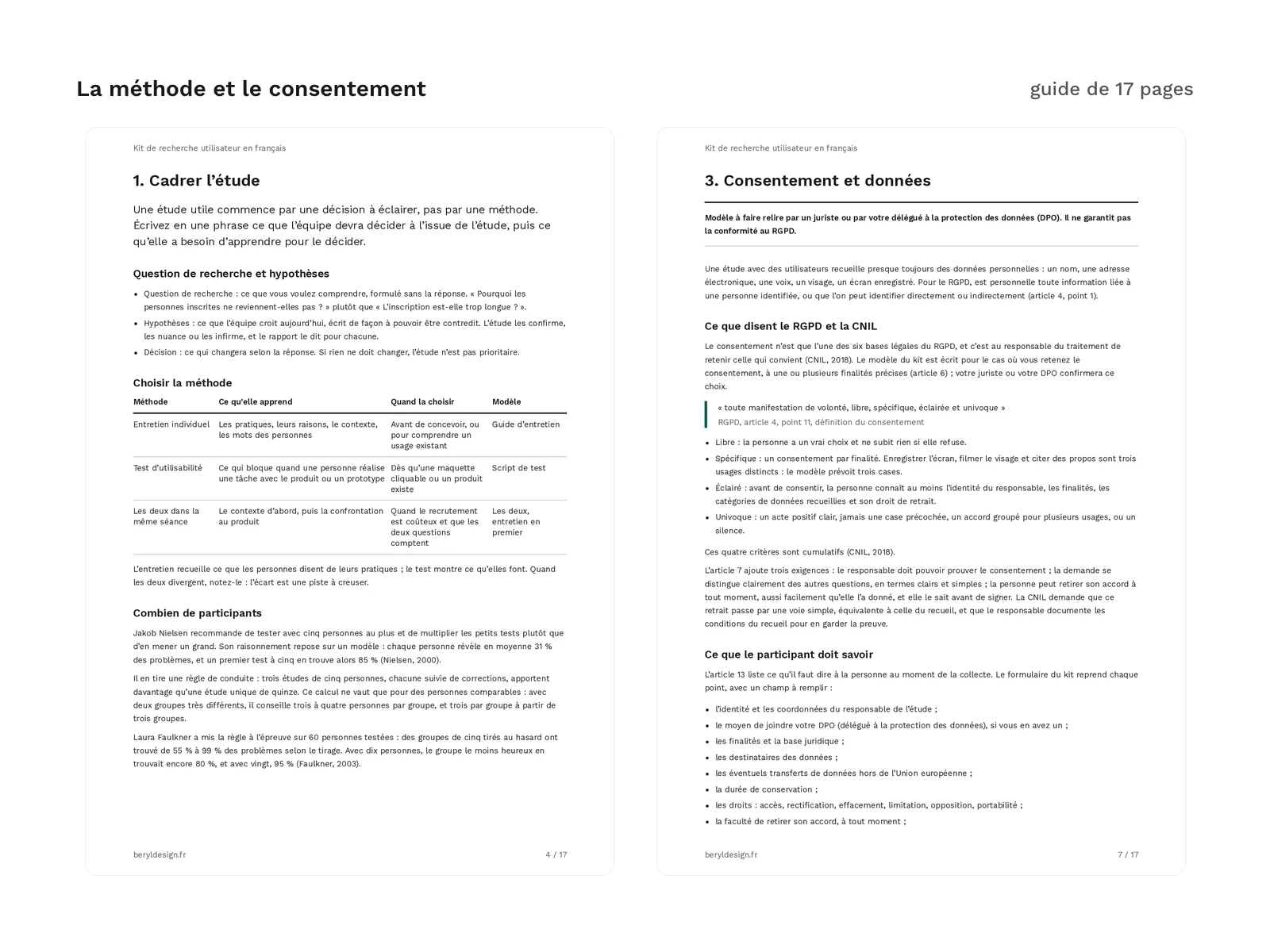
- A 17-page PDF guide: how to use the kit, the 6-step method, scoping (research question, hypotheses, choosing between interview and test, number of participants), recruiting, consent and data, preparing sessions, running an interview and a test, synthesis, persona and empathy map, reporting back, the template overview, sources and colophon. The table of contents and bookmarks lead to each part.
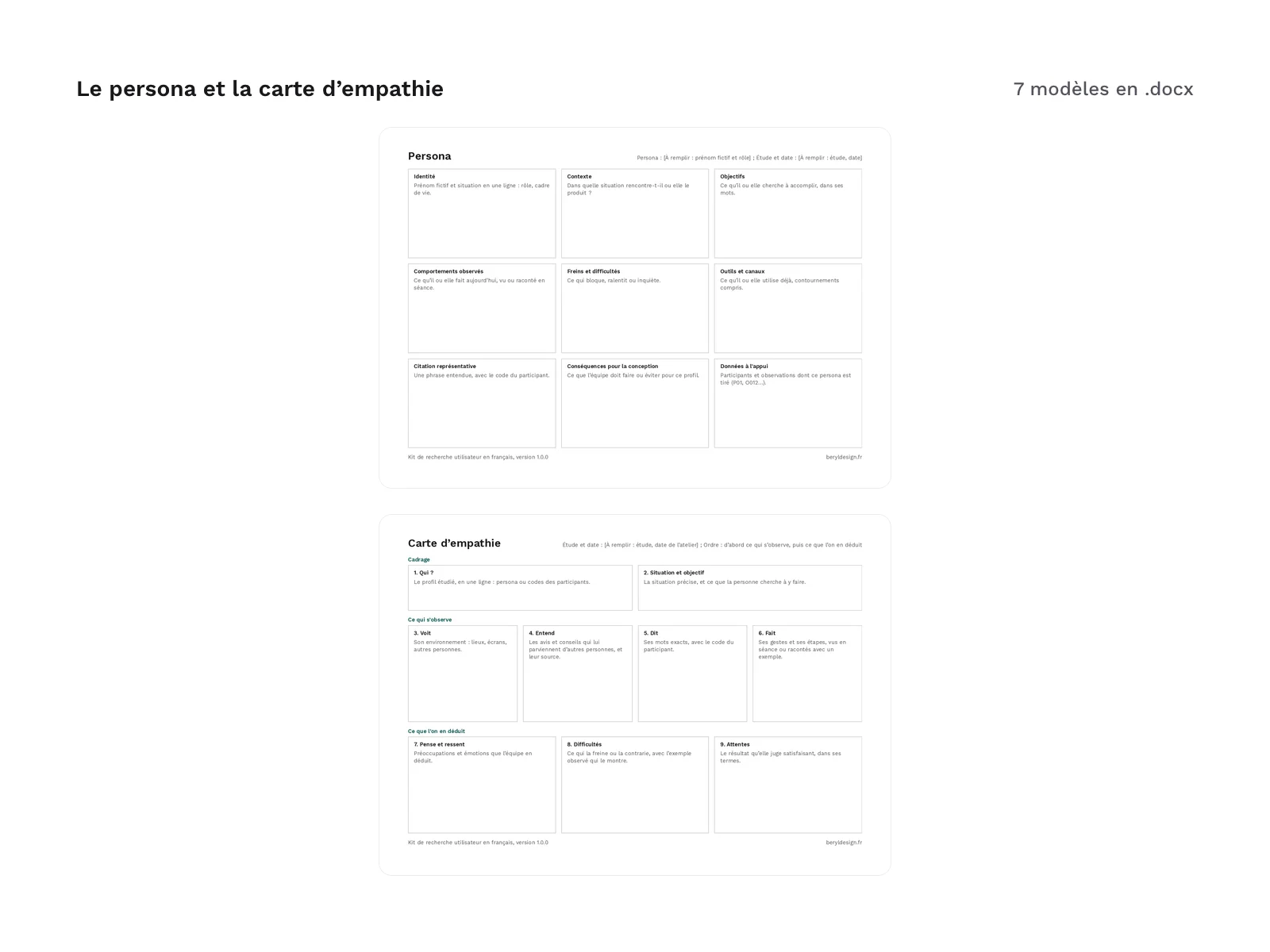
- 8 ready-to-fill templates: interview guide, usability test script, consent form, recruitment screener, persona, empathy map, research report and synthesis grid. The first 7 come as Markdown and DOCX, with the same headings in the same order; the synthesis grid is a spreadsheet. Fields to complete are marked « [À remplir : …] » (“to fill in”) and checkboxes are empty.
- 2 printable boards: the persona and the empathy map also come as landscape A4 PDFs, to fill in by hand in a workshop.
- A synthesis grid (.xlsx) with 6 sheets: Mode d’emploi (how to use), Recrutement (recruiting), Participants, Observations, Thèmes (themes) and Constats (findings). It walks you from observations to themes, counts the observations and participants behind each theme, and ties each finding to its evidence. The Participants and Observations sheets also come as CSV, to use in another tool.
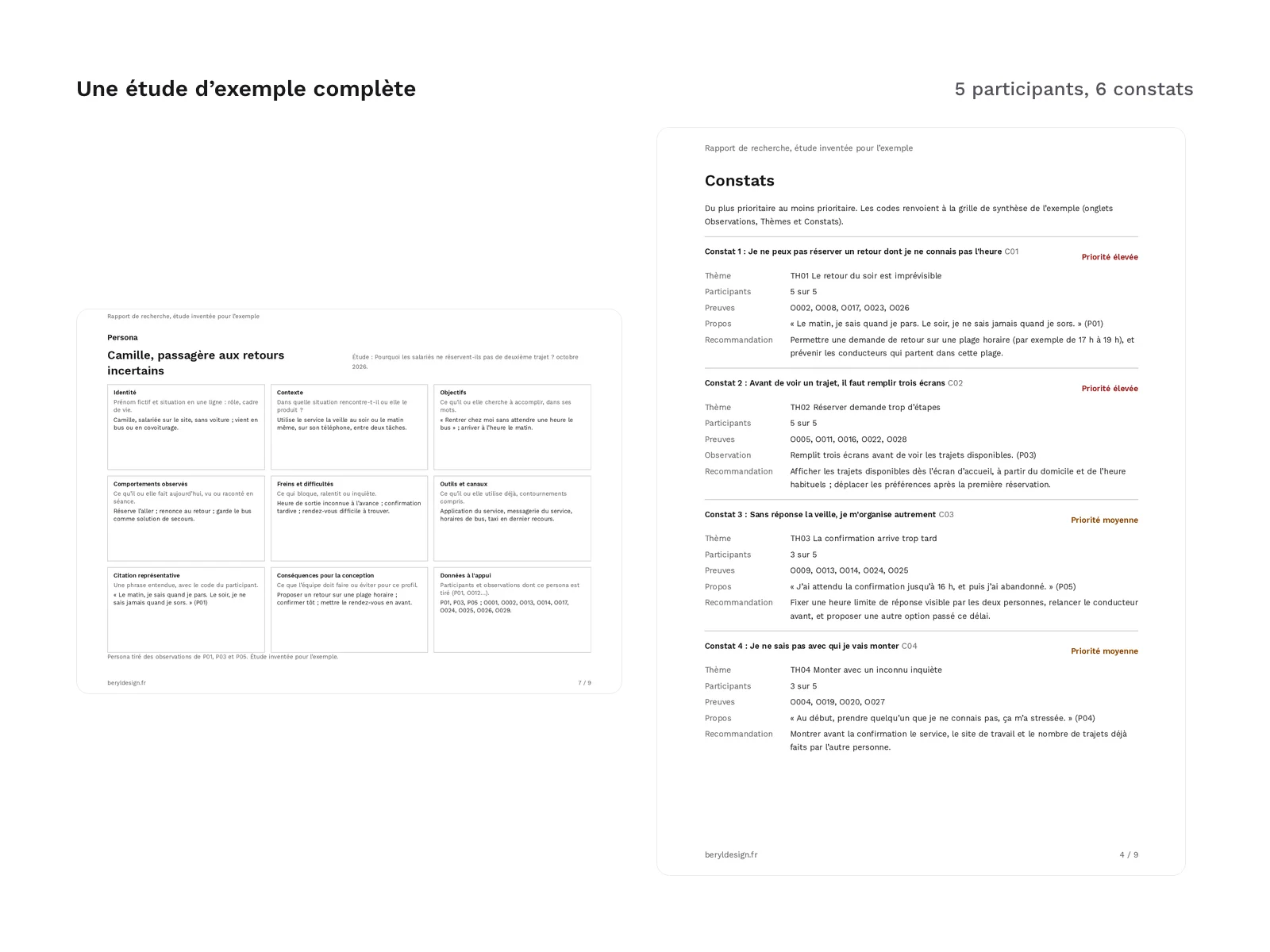
- An example study: a filled 9-page report (PDF), with a persona, an empathy map and note excerpts, and the filled synthesis grid. The study is about a home-to-work carpooling app invented for the example: 5 participants, 29 observations, 6 themes and 6 findings. The service, its participants and their words are made up.
Kit files:
guide-recherche-utilisateur.pdf
modeles/guide-entretien.md
modeles/guide-entretien.docx
modeles/script-test-utilisateur.md
modeles/script-test-utilisateur.docx
modeles/formulaire-consentement.md
modeles/formulaire-consentement.docx
modeles/screener-recrutement.md
modeles/screener-recrutement.docx
modeles/persona.md
modeles/persona.docx
modeles/persona.pdf
modeles/carte-empathie.md
modeles/carte-empathie.docx
modeles/carte-empathie.pdf
modeles/rapport-recherche.md
modeles/rapport-recherche.docx
tableur/synthese-recherche.xlsx
tableur/participants.csv
tableur/observations.csv
exemple/etude-exemple.pdf
exemple/synthese-exemple.xlsx
The zip also contains the license text and the credits.
Consent and personal data
The consent form helps you collect participants’ agreement one use at a time (taking part, audio recording, screen, face, quotes, follow-up contact) and tell each person what applies to them. The guide explains how to pseudonymize notes and the spreadsheet, by giving each participant a code and keeping the table that links codes to names separately, and how to limit the data you collect and how long you keep it. The form is a template: have it reviewed by a lawyer or by your data protection officer (DPO). It does not guarantee GDPR compliance.
Sources
The references are those of the guide, consulted on 11 November 2026 and checked one by one against their source:
- the General Data Protection Regulation (GDPR) and the pages of the CNIL, the French data protection authority, on consent, people’s rights and complaints;
- the French Civil Code, on the right to respect for private life;
- Jakob Nielsen (2000), on the number of participants in a usability test, and Laura Faulkner (2003), who put that rule to the test. The guide sets out both positions and their limits, then says what it takes from them;
- Jakob Nielsen (2012), on thinking aloud;
- Alan Cooper (1999 and 2008), on the origin of personas;
- Dave Gray and his co-authors (2010), then Dave Gray (2017), on the empathy map. The kit cites the concept; its map is an original grid that takes neither the layout nor the questions of Dave Gray’s canvas.
The rest of the guide and the templates is rephrased or written by the kit’s author. None of these authors is associated with the kit.
Production and AI
The texts of the guide, the templates and the example study, as well as the layout and spreadsheet scripts, were written with an AI assistant, then reviewed and checked: every reference verified against its source, PDFs tagged and tested, figures recounted by script. No image was made with an image generator.
Formats and compatibility
- Tagged A4 PDF (guide and example study): real text you can select and copy, structured headings, bookmarks, language declared as French; the guide’s links are live. The PDFs open in any PDF reader and print on A4.
- Landscape A4 PDF (persona and empathy map): boards to print and fill in by hand.
- DOCX: the 7 templates open in any word processor, with the word processor’s heading styles and French as the language, with no font imposed: they take your document’s font.
- Markdown: the same templates paste into a wiki, a note-taking tool or a code repository, and can be completed in any text editor.
- XLSX: the synthesis grid and its filled version open in common spreadsheet apps; drop-down lists guide data entry, the header row stays visible when scrolling and the counts recalculate on opening.
- CSV UTF-8: with BOM and semicolon-separated, it opens directly in a spreadsheet set to French (headers in French).
- Font: the PDFs are set in Work Sans, under the SIL Open Font License 1.1, embedded as a subset.
Good to know before you buy:
- The whole kit is in French: guide, templates, spreadsheet and example.
- The PDFs are tagged (headings, bookmarks, real text, language), but their conformance to the PDF/UA standard has not been measured with a validation tool. If you need to hand over an accessible document, start from the DOCX or Markdown template.
- When printed, only the Mode d’emploi sheet of the spreadsheet fits the width of a page; the other sheets print across several pages. The spreadsheet is meant to be filled in on screen.
- The kit supports a study; it does not guarantee a result, and the consent form does not replace legal advice.
License
The kit is sold under the commercial license (terms in French): you may use and modify the templates for your own studies and for your clients’ studies, and hand your clients the reports you build from them, but you may not resell or redistribute the kit’s files, in whole or in part.
Further reading
Version history
1.0.0 (11 November 2026): first version.