Preview 1 of 4
Browser management game UX audit kit: 40 criteria, scoring grid and filled example (PDF and spreadsheet)
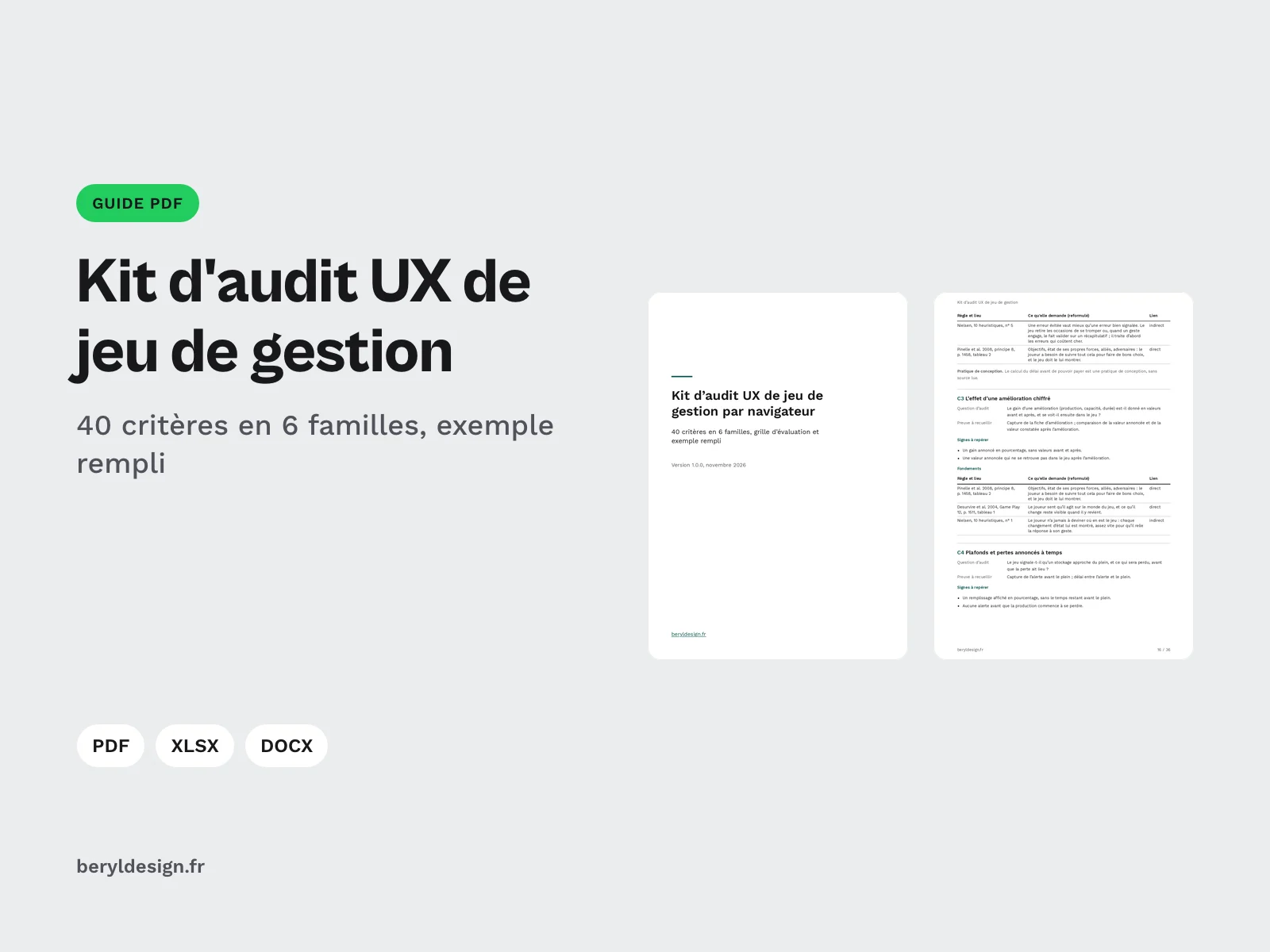
40 criteria in 6 families, a working grid, a report template and an example filled in on an invented game, to audit your management game UI. In French.
Overview
Description
The kit is written in French. Every file is in French: the guide, the grid, the report template and the example. It is meant for independent developers of browser management games, and for the designers who work with them: people who want to spot, before their testers do, what will make a player drop out. It supports an expert inspection of the interface. You play over several days, in short sessions, on a computer and on a phone; you give each of the 40 criteria a status; you write one finding per problem, with its severity; then you hand a report to your team or your client.
The kit builds on published game and interface heuristics. None of them deals with browser management games as such: the kit applies them to this genre, and each criterion states whether its rule supports it directly or only in part. It judges whether the player learns, controls and understands the game, not whether the game is fun, balanced or well told. It is not a certification, nor a full accessibility audit, and an expert inspection does not replace a test with players: it prepares one. The filled example is about a game invented for the purpose; no existing game is named or assessed in the kit.
Specifications
| Criteria | 40 in 6 families |
|---|---|
| Statuses and severity | 4 statuses, 5 severity levels |
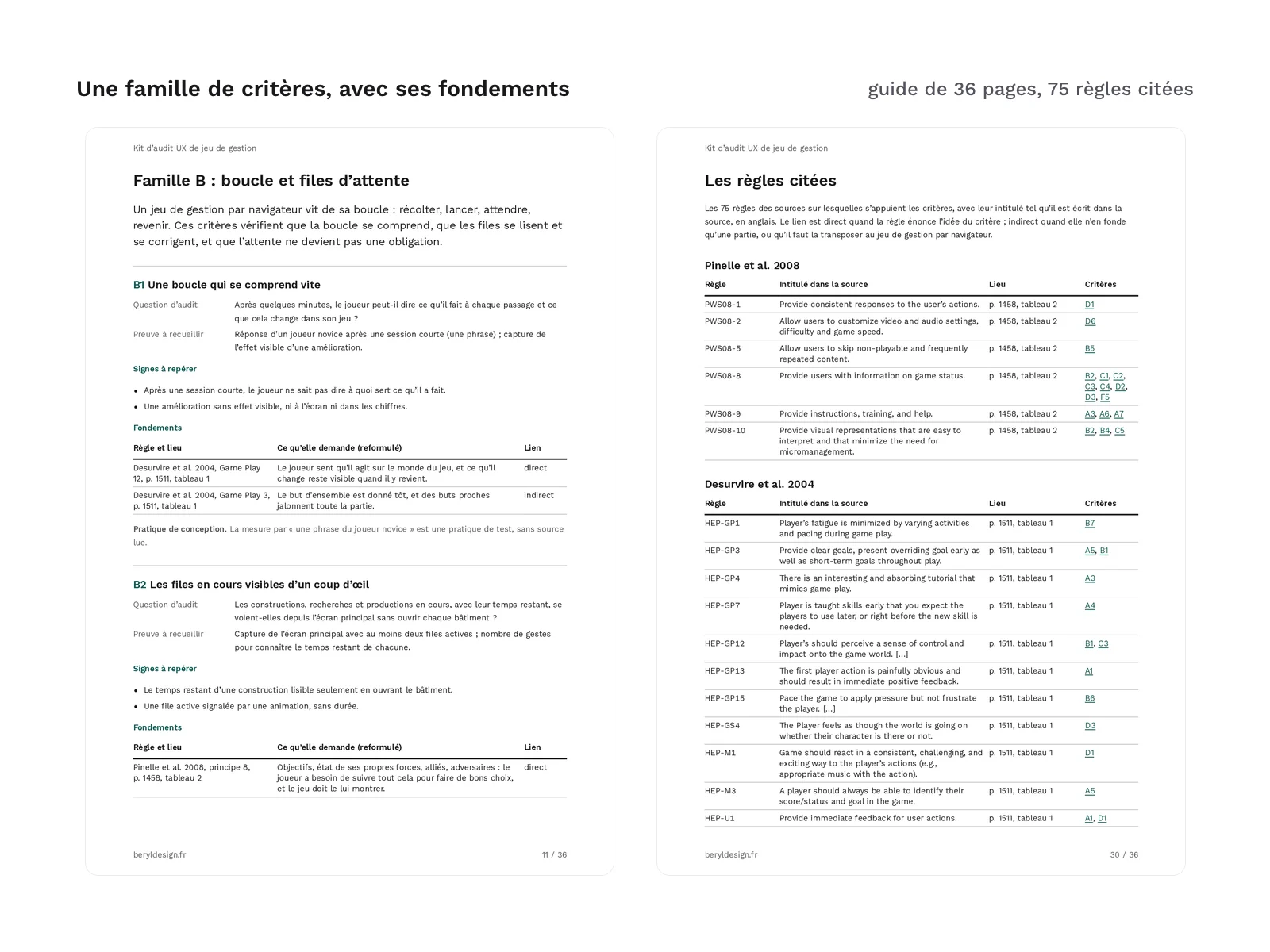
| Rules cited | 75, from 9 sources |
| Guide | 36-page PDF |
| Filled-in example | 13 pages |
| Formats | tagged A4 PDF, XLSX, UTF-8 CSV, Markdown, DOCX |
| License | commercial (page in French) |
| Version | 1.0.0 of November 12, 2026 |
Contents
- A 36-page PDF guide: how to use it and the method (scope, play and record, assess, rate, report), statuses and severity, a table of the 40 criteria with the page of each, one section per family, the cited rules, the report template, the sources and the colophon. The table of contents gives the page of each part.
- 40 criteria in 6 families: onboarding, loop and queues, readable economy, feedback and notifications, mobile and short sessions, social and alliances. Each criterion has an audit question, the evidence to collect, signs to look for and its grounds: the source rule, where it can be read and the kind of link, direct or indirect. When part of a criterion rests on no source that was read, the sheet says so under “design practice”. The same identifier follows each criterion from the guide to the grid and the report.
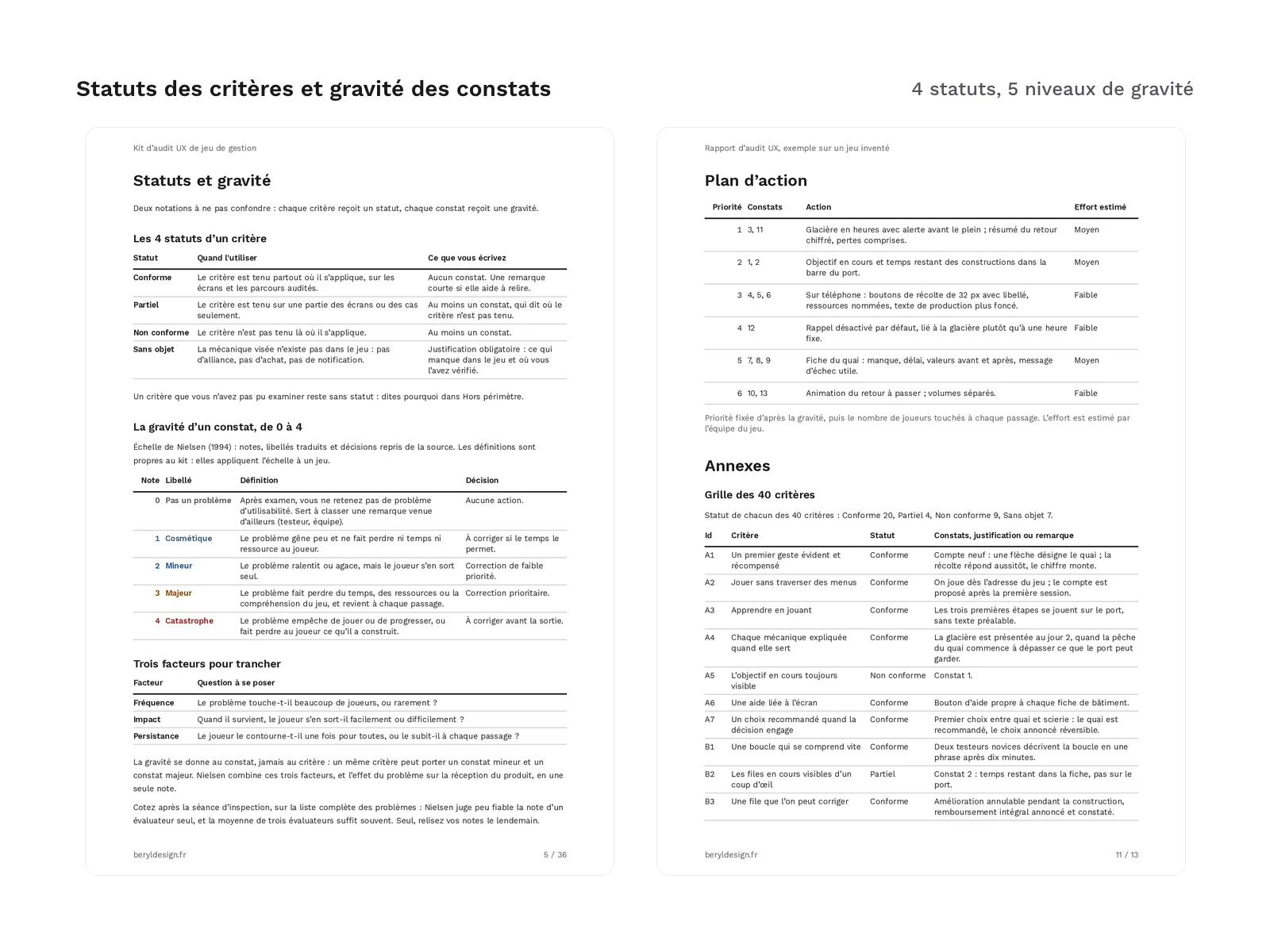
- 4 statuses for a criterion: compliant, partial, non-compliant, not applicable. A criterion marked not applicable needs a justification: what is missing from the game and where you checked.
- 5 severity levels for a finding, from “not a problem” to “catastrophe”, on Nielsen’s scale (1994), decided by the frequency, impact and persistence of the problem. Severity is given to the finding, never to the criterion.
- The 75 cited rules, with their original English title and a reworded summary, and the 9 sources of the guide, with the date they were consulted.
- A working grid (.xlsx): sheets for instructions, criteria (status from a drop-down list, justification, linked findings), findings (criterion and severity from lists) and scales, with automatic counts.
- The 40 criteria as CSV, to reuse them in another tool: identifier, family, criterion, audit question, evidence to collect, grounds.
- A blank report template, in Markdown and DOCX: context and scope, method, summary, findings, action plan, appendices. The fields to fill in are marked “[À remplir : …]”.
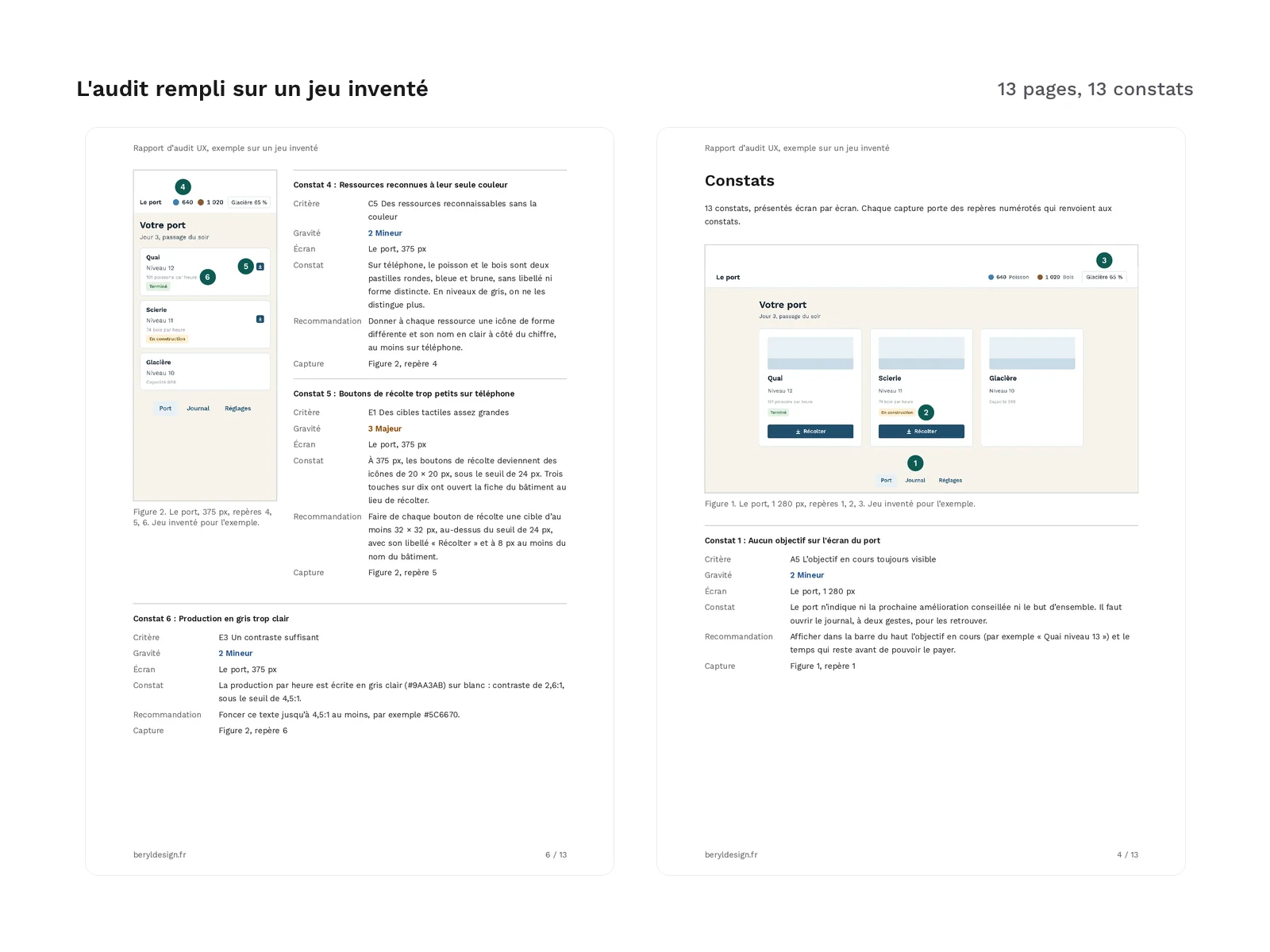
- A filled example: a 13-page PDF report and its filled grid (.xlsx), on an invented fishing harbour game. 4 screens captured on a computer and on a phone, 13 findings placed on the captures, all 40 criteria assessed, 7 of them not applicable, each one justified. The screens were written for the example; the game team and the evaluator have invented first names.
Kit files:
guide-audit-ux-jeu.pdf
grille/grille-audit-ux-jeu.xlsx
grille/criteres.csv
rapport/modele-rapport.md
rapport/modele-rapport.docx
exemple/rapport-exemple.pdf
exemple/grille-exemple.xlsx
Sources
The guide’s references, each checked against its text:
- Pinelle, D., Wong, N. and Stach, T. (2008). Heuristic Evaluation for Games: Usability Principles for Video Game Design. CHI 2008 proceedings, ACM.
- Desurvire, H., Caplan, M. and Toth, J. A. (2004). Using Heuristics to Evaluate the Playability of Games. CHI 2004 Extended Abstracts, ACM.
- Zagal, J. P., Björk, S. and Lewis, C. (2013). Dark Patterns in the Design of Games. FDG 2013 proceedings.
- Nielsen, J. Usability heuristics for user interface design (1994, page reviewed on 30 January 2024) and severity ratings for usability problems (1 November 1994), Nielsen Norman Group.
- Game accessibility guidelines, full list of guidelines.
- W3C, Web Content Accessibility Guidelines (WCAG), recommendation of 12 December 2024.
The rules are summarised in the kit author’s own words; quotations are short and give their source and page. The real games used as examples in the papers are not repeated.
Production and AI
The kit’s texts were written with an AI assistant, then reviewed and checked: every reference verified against its source, PDF tagged and tested, figures recounted by script. The example game’s screens were written for the purpose and then captured; no image was made with an image generator.
Formats and compatibility
- Tagged A4 PDF (guide and example): real, selectable and copyable text, structured headings and live links. The PDFs open in any PDF reader and print on A4.
- XLSX: the grid and the example open in common spreadsheet applications; the drop-down lists and counts work there.
- UTF-8 CSV: semicolon-separated, it opens in a spreadsheet set to French.
- Markdown: the report template can be read and filled in with any text editor.
- DOCX: the same template for a word processor, with no imposed font.
- Font: the PDFs are set in Work Sans, under the SIL OFL 1.1 license, embedded as a subset.
Before you buy:
- The whole kit is in French: guide, grid, report template and example. The titles of the cited rules stay in English, the language of their sources.
- The kit targets browser management games played in short sessions. If your game has no alliances or purchases, the related criteria become not applicable, with their justification.
- A few criteria draw on accessibility rules without amounting to an accessibility audit. The criteria about purchases judge how clear things are to the player, not the legal compliance of a paid offer.
- The PDFs are tagged, but their conformance to the PDF/UA standard is not certified. If you must deliver an accessible document, start from the DOCX or Markdown template.
License
The kit is sold under the commercial license (terms in French): you may use it for your own audits and for audits billed to your clients, and quote extracts from it in your reports, but you may not resell or share the kit itself, modified or not.
Further reading
- Jeux de gestion par navigateur : des classiques comparés par leur boucle économique (in French)
- La loi de Hick et les menus des jeux de gestion (in French)
- French UX audit kit: to audit a website or an app outside games, with Bastien and Scapin’s ergonomic criteria (in French).
Version history
1.0.0 (12 November 2026): first version.