Preview 1 of 4
French game design document template: 10 sections, economy spreadsheet and filled example (PDF, DOCX, Markdown, XLSX)
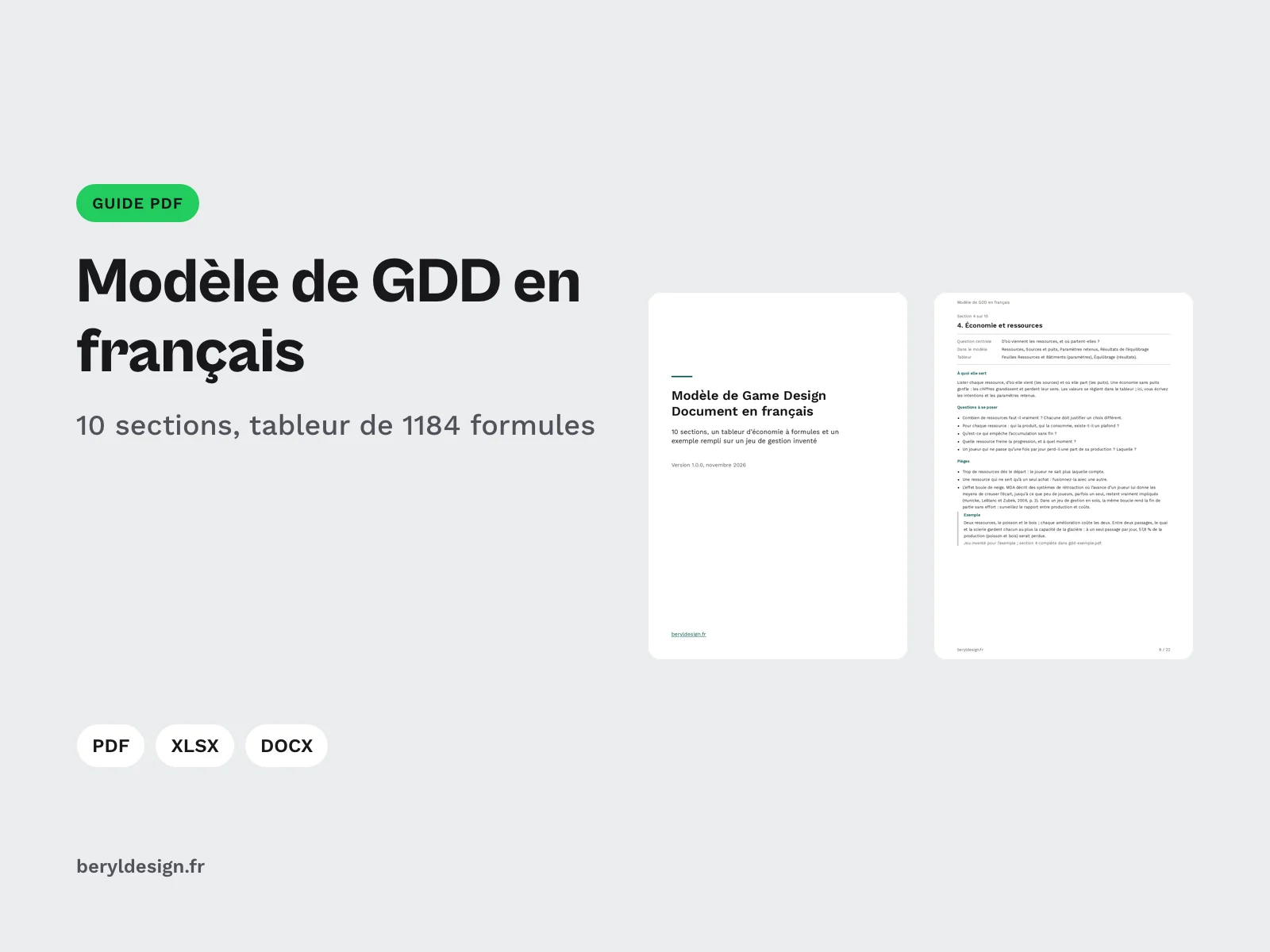
A GDD template in French for management and progression games: 10 sections, an economy spreadsheet with formulas and a filled example. Written in French.
Overview
Description
This game design document template is aimed at management and progression games: its economy spreadsheet and its sections 4 and 5 (Economy and resources, Progression) put numbers on buildings, resources and levels. The other sections fit most small games, but if yours is built on combat, skill or story, the spreadsheet does not model it.
The kit is written in French. Every file is in French: the guide, the template, the spreadsheet and the example. It is meant for independent developers, small studios, students and designers who are working on a small game, in the browser or independent, and want a design document in French. You get a template to fill in, a guide that explains each section, a spreadsheet that computes the economy and the same document filled in for an invented management game. The kit supports writing the GDD; it does not design the game for you and does not guarantee its balance.
Specifications
| Blank template | 10 sections, 33 subsections |
|---|---|
| Economy spreadsheet | 6 sheets, 1,184 formulas |
| Guide | 22-page PDF |
| Filled-in example | 8 pages |
| Formats | tagged A4 PDF, DOCX, Markdown, XLSX with formulas, UTF-8 CSV |
| License | commercial (page in French) |
| Version | 1.0.0 of November 11, 2026 |
Contents
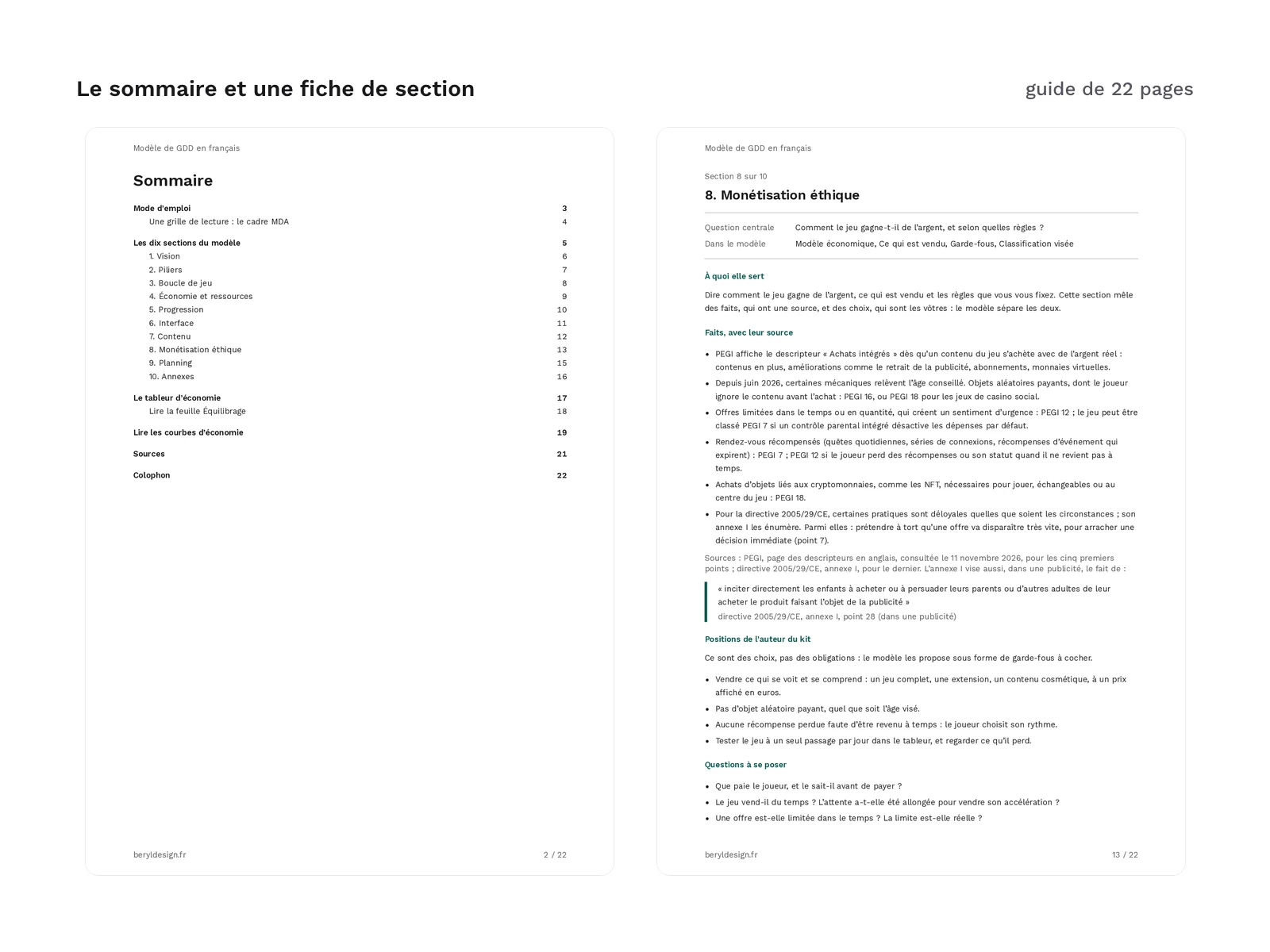
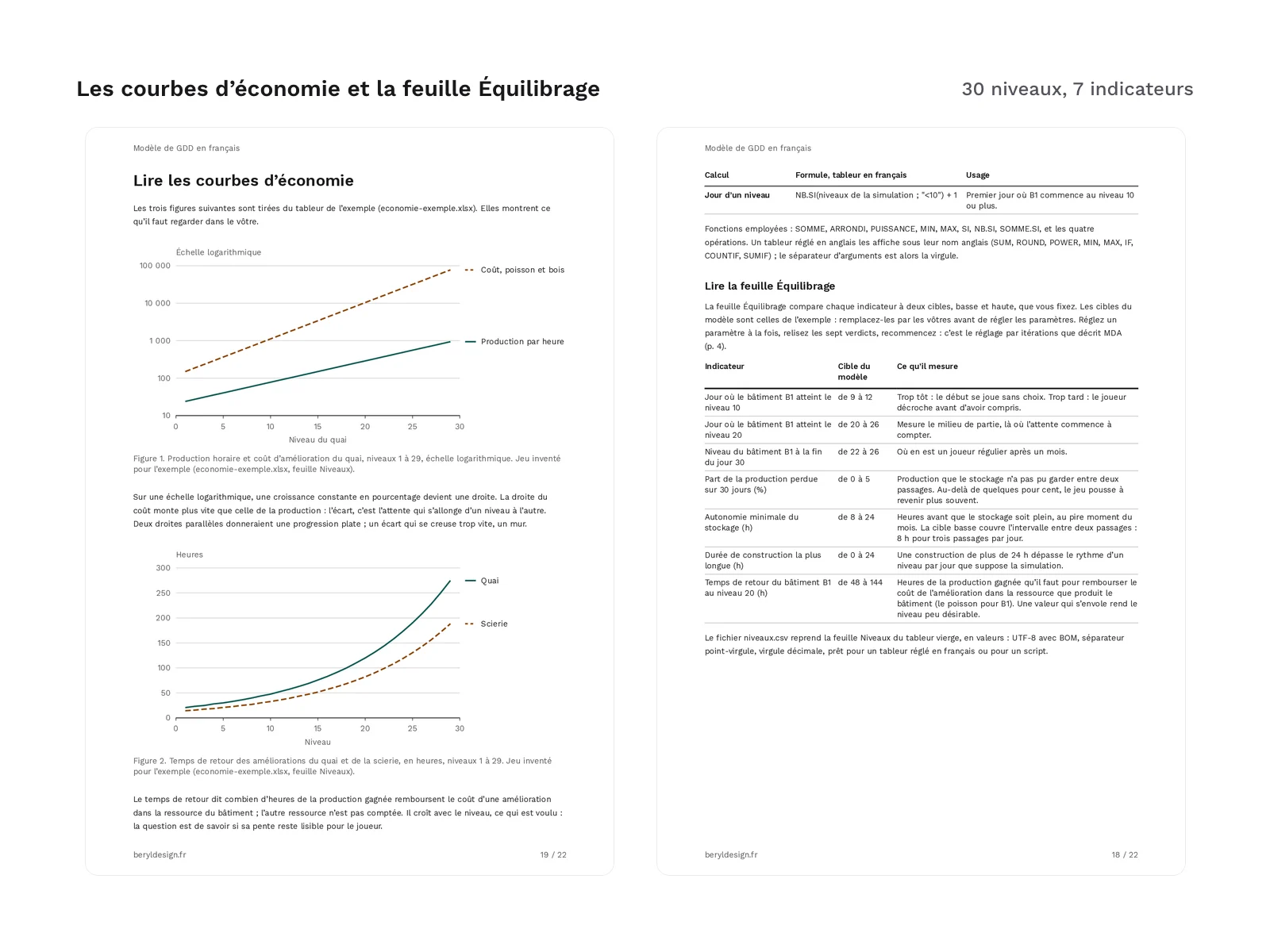
- A 22-page PDF guide: how to use the kit and the method, a reading grid drawn from the MDA framework, one sheet per section (what it is for, the questions to ask, the pitfalls), the spreadsheet explained formula by formula, how to read the Balancing sheet and the 3 economy curves, the sources and the colophon. The table of contents and the bookmarks lead to every part.
- A blank template with 10 sections and 33 subsections, in Markdown and DOCX: Vision, Pillars, Game loop, Economy and resources, Progression, Interface, Content, Ethical monetisation, Planning, Appendices. Fields to complete are marked « [À remplir : …] » (to be filled in). The Ethical monetisation section offers 7 safeguards as checkboxes.
- An economy spreadsheet with formulas (.xlsx), 6 sheets and 1,184 formulas: instructions, resources, buildings, levels, simulation and balancing (sheet names are in French). It models 3 buildings (producers and a storage), 2 resources and 30 levels per building, then simulates 30 days of a regular player. The balancing sheet compares 7 indicators with a low and a high target that you set, and computes a verdict for each. The parameter cells, on a pale yellow background, are the only ones to change: everything else recalculates.
- The levels as CSV: the 30 levels of the blank spreadsheet, as values, to reuse in a game engine or a script.
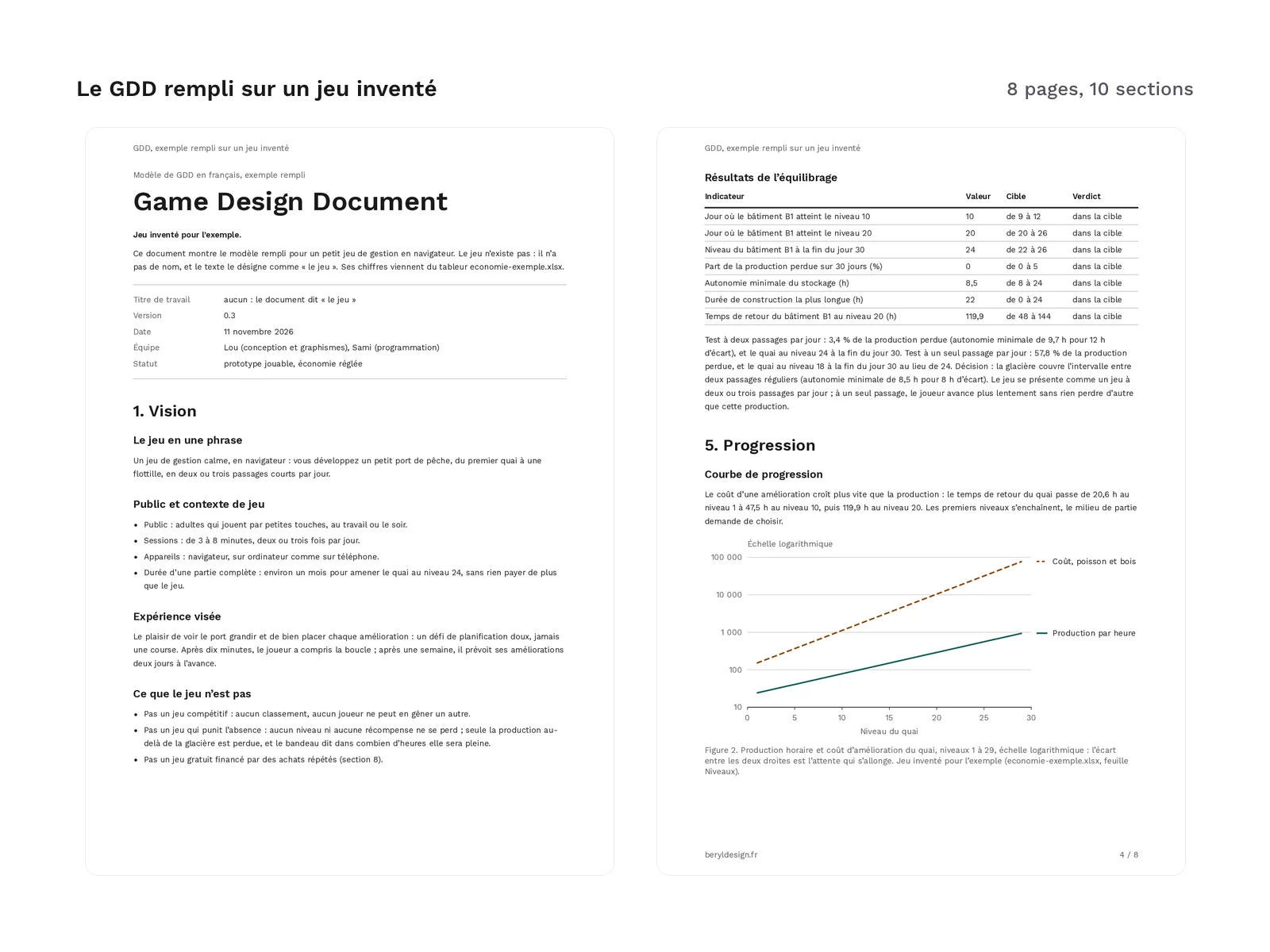
- An 8-page filled example (PDF, with its Markdown version and its tuned spreadsheet): a calm management game in the browser, invented for the example, where you grow a small fishing port. All 10 sections are filled in and the economy is computed by the spreadsheet. No existing game and no real person is named.
Files in the kit:
guide-gdd.pdf
modele/gdd-modele.md
modele/gdd-modele.docx
tableur/economie-modele.xlsx
tableur/niveaux.csv
exemple/gdd-exemple.pdf
exemple/gdd-exemple.md
exemple/economie-exemple.xlsx
The zip also contains the licence text, a read-me file and the credits.
How to use it
- Set the vision and the pillars in the template, in Markdown or DOCX, and read them again before every important decision.
- Describe the game loop: what the player does, and what each action brings them.
- Put numbers on the economy in the spreadsheet. First replace the targets of the balancing sheet, which are those of the example, with your own. Then change one parameter at a time, read the 7 verdicts again and start over. Carry the results into sections 4 and 5.
- Complete the rest (interface, content, monetisation, planning) in the order that suits you, then date each version in the appendices.
Keep the example open next to the template: every section is filled in, with its figures and curves, for a game that does not exist.
Good to know before you buy
- The whole kit is in French: guide, template, spreadsheet and example.
- The spreadsheet and sections 4 and 5 are aimed at management and progression games. The spreadsheet models 3 buildings and 2 resources: beyond that, you extend the formulas yourself. Its simulation follows a regular player, at most one level per building per day: it gives an order of magnitude to tune the economy, it does not replace a playtest.
- The Ethical monetisation section relies on sourced references and on the author’s own positions, presented as such. It is not legal advice.
- The PDFs are tagged (headings, bookmarks, declared language, real text), but their conformance with the PDF/UA standard has not been measured by a validator. If you need to hand over an accessible document, start from the DOCX or Markdown template.
- A spreadsheet app set to English shows the functions under their English names; the guide gives the correspondence.
Sources
The guide relies on named sources, consulted on 11 November 2026: the MDA framework by Hunicke, LeBlanc and Zubek (2004), the PEGI labels page and the European directive on unfair commercial practices. Quotations are short, with their page or point; the explanations, questions, pitfalls, template and example are written by the author of the kit.
Production and AI
The texts of the guide, the template and the example, the tuning of the example’s economy and the layout and calculation scripts were produced with an AI assistant, then reviewed and checked: each reference verified against its source, PDFs tagged and tested, formulas recalculated by a second calculation engine, figures recounted by script. No image was made by an image generator: the curves are drawn from the spreadsheet’s calculations.
Formats and compatibility
- Tagged A4 PDF (guide and example): real text, selectable and copyable, structured headings, bookmarks, language declared as French; the guide’s links are active. The PDFs open in any PDF reader and print on A4.
- DOCX: the template for a word processor, headings in heading styles, with no font imposed: it takes your document’s font.
- Markdown: the template and the example, with no HTML tags, can be read and completed in any text editor.
- XLSX with formulas: both spreadsheets open in common spreadsheet apps, with frozen headers; they open and export without errors in LibreOffice, as does the DOCX template.
- CSV UTF-8: with BOM, semicolon separator and decimal comma, ready for a spreadsheet set to French or for a script.
- Font: the PDFs are set in Work Sans, under the SIL Open Font License 1.1, embedded as a subset.
Licence
The kit is sold with the commercial licence: you can use it for your own games and for your clients’ games, and hand the documents you produce with it to your team, a client or a publisher, but you cannot resell or redistribute the kit, in whole or in part.
Further reading
- Browser management games: their economic loops compared, to feed the Game loop and Economy and resources sections.
- Ce que les jeux idle apprennent à l’UX produit (in French), on progression loops.
- Rethinking the tech tree of a management game: lessons from Dynasty Nova, the game I am developing.
Version history
1.0.0 (11 November 2026): first version.