Preview 1 of 4
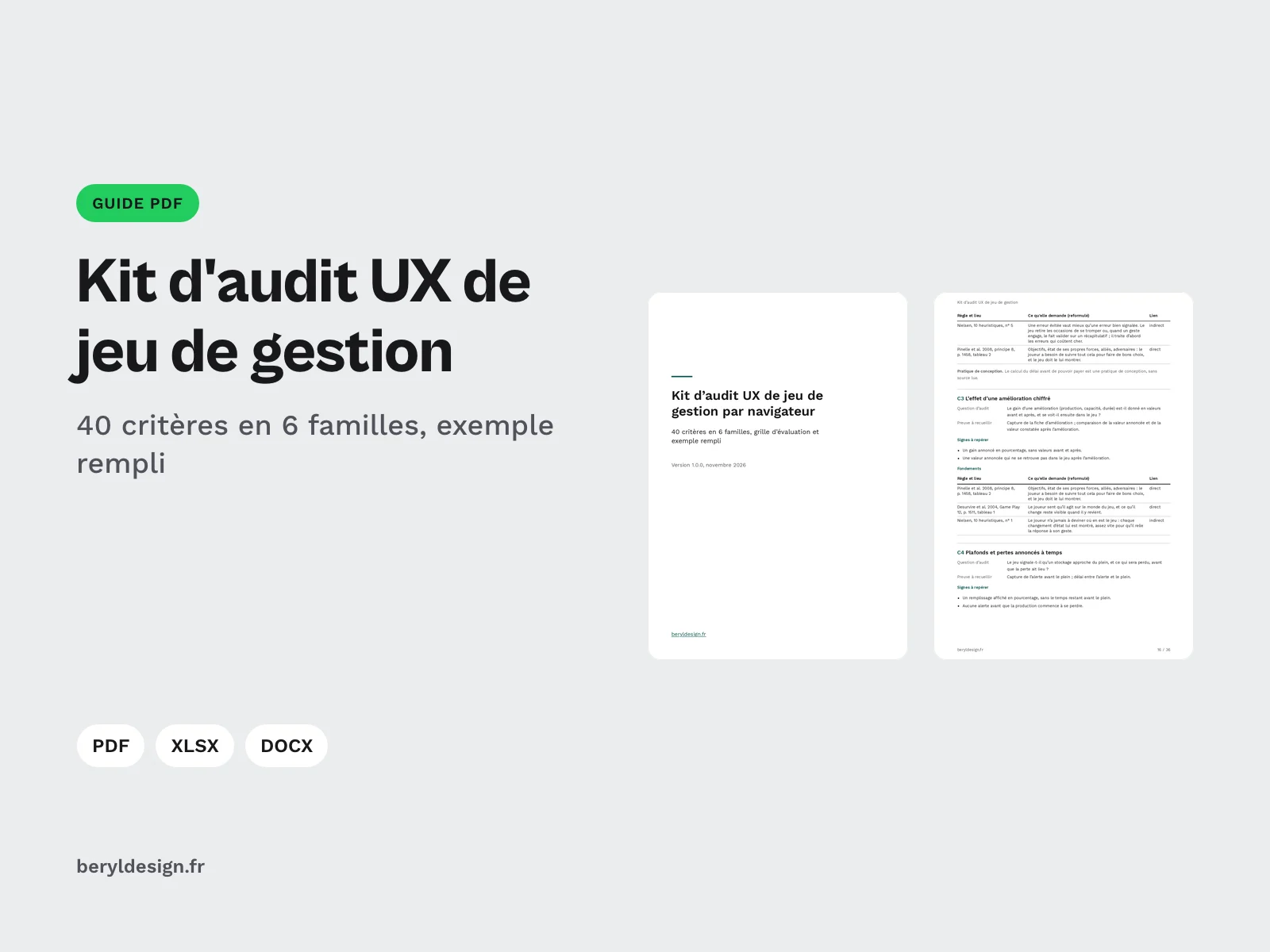
French UX audit kit: 18 ergonomic criteria, 6 checklists and report template (PDF and spreadsheet)
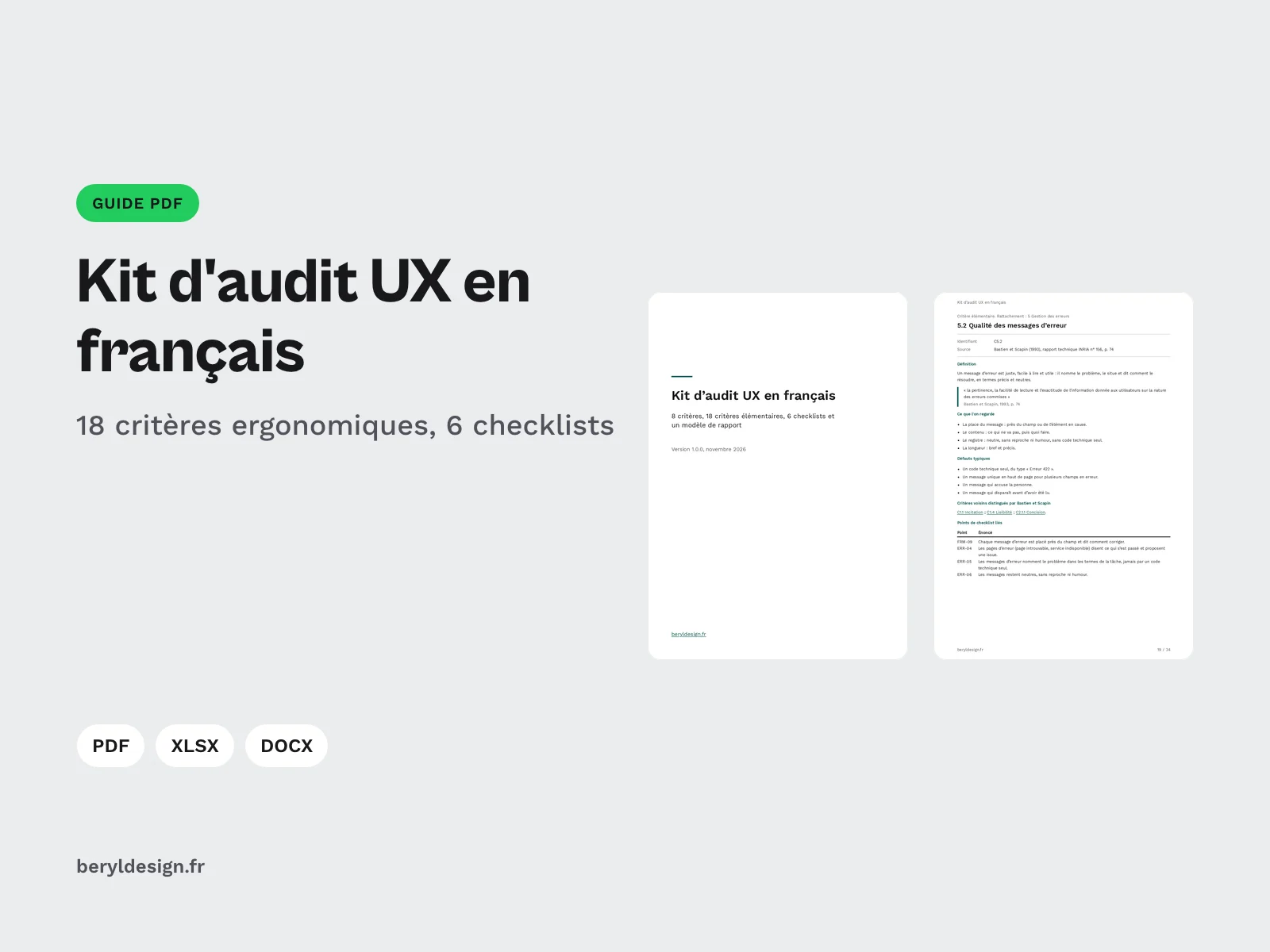
Bastien and Scapin's criteria, 6 checklists, a severity scale and a report template, as PDF and spreadsheet, to run UX audits in French. Written in French.
Overview
Description
The kit is written in French. Every file is in French: the guide, the spreadsheet, the checklists, the report template and the example. It is meant for UX and UI designers, freelancers and agencies who run or bill an ergonomic audit of an interface in French. It supports an expert inspection: one or two people review a website or an app against known criteria, without users. It builds on Bastien and Scapin’s ergonomic criteria (INRIA, 1993), adds a crosswalk to Nielsen’s 10 heuristics, and takes you from scoping to the report you hand to your client: method, criterion sheets, checklists, severity scale, working spreadsheet and report template, with a filled example.
The kit supports an ergonomic audit; it does not guarantee a result. It is neither an accessibility audit in the RGAA sense nor a certification, and an expert inspection does not replace a test with users.
Specifications
| Criteria | 8 main, 18 elementary |
|---|---|
| Mapping table | to 10 heuristics |
| Checklists | 6, 63 items |
| Severity scale | 4 levels |
| Guide | 34-page PDF |
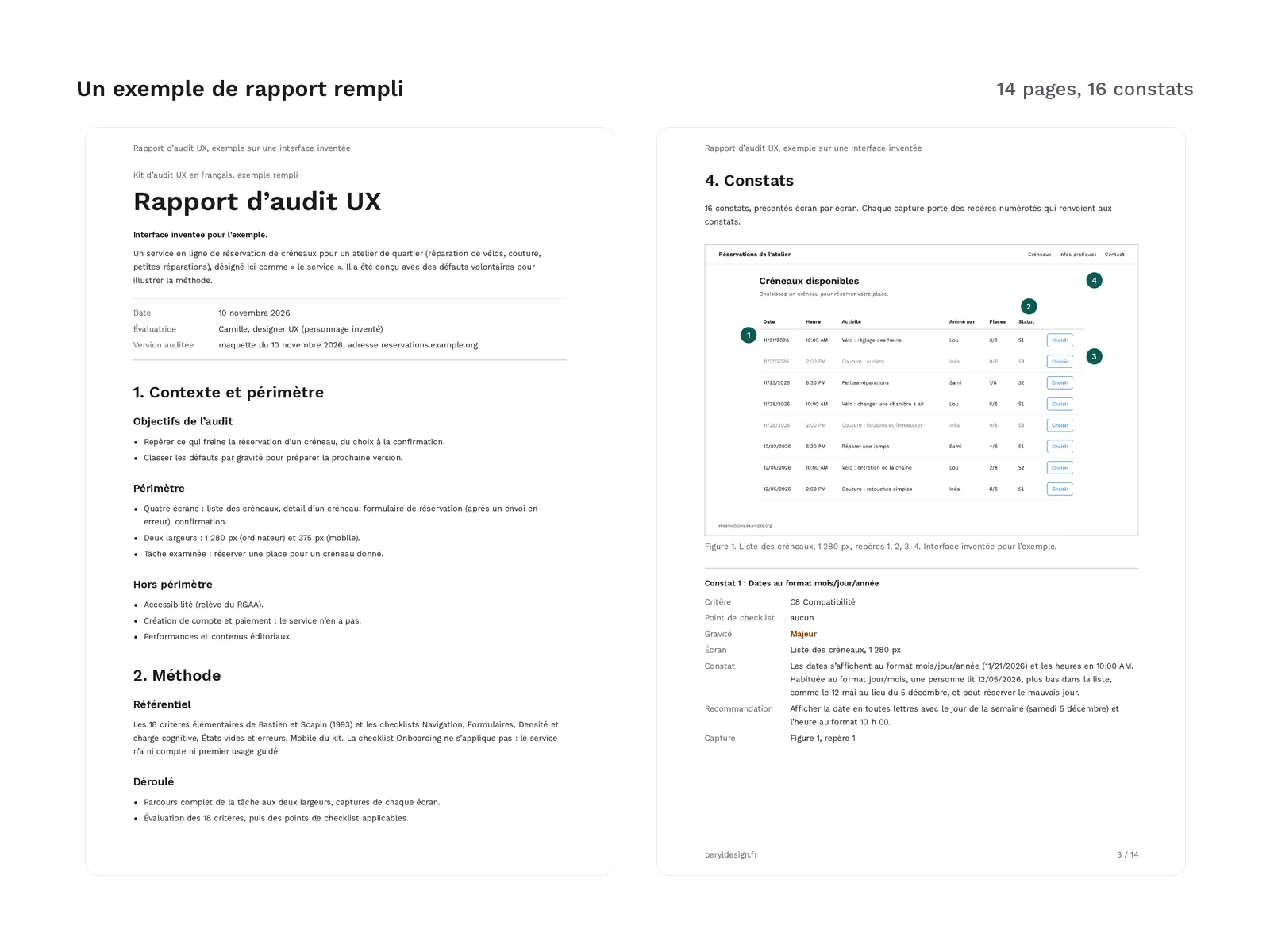
| Filled-in example | 14 pages |
| Formats | tagged A4 PDF, XLSX, UTF-8 CSV, Markdown, DOCX |
| License | commercial (page in French) |
| Version | 1.0.0 of November 10, 2026 |
Contents
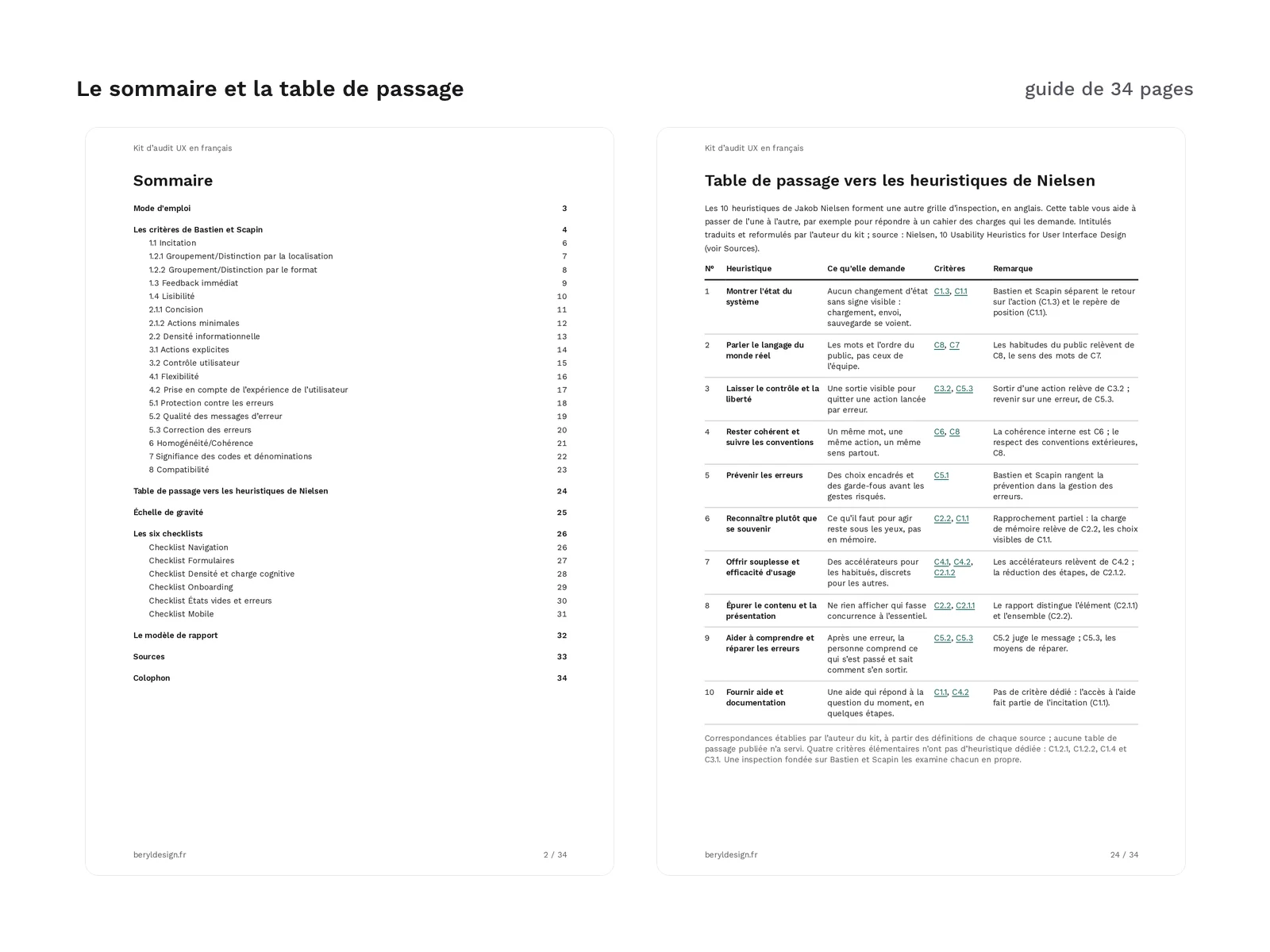
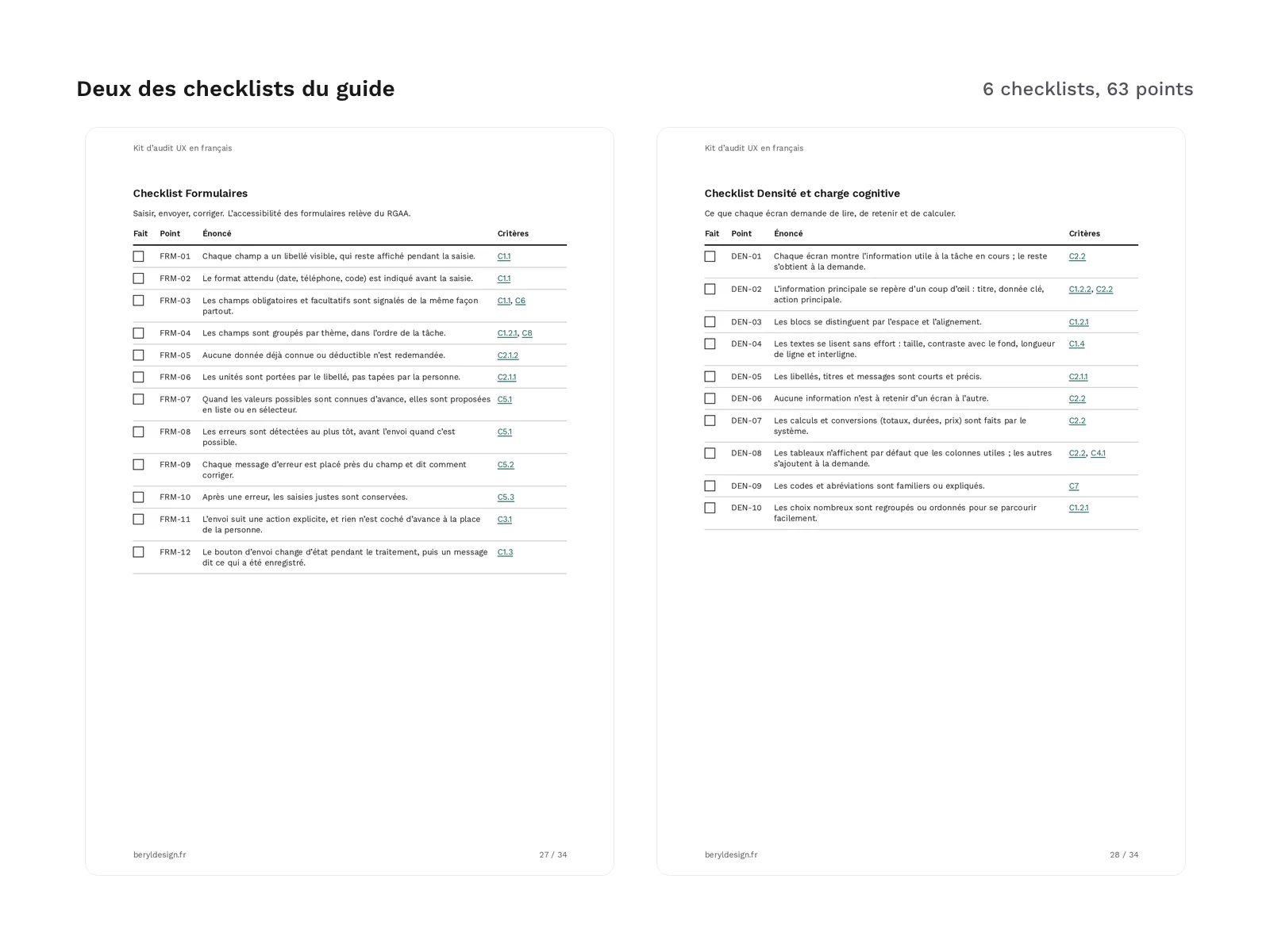
- A 34-page PDF guide: instructions and method (scope, walk through, evaluate, rate, report), one sheet per elementary criterion, the crosswalk, the severity scale, the 6 printable checklists, an introduction to the report template, the sources and the colophon. The table of contents and the bookmarks lead to each part.
- 8 main criteria, 18 elementary criteria from Bastien and Scapin: guidance, workload, explicit control, adaptability, error management, homogeneity and consistency, significance of codes and names, compatibility. Each elementary criterion has its sheet: title and page in the source, a rephrased definition, a short quotation, what to look at, typical defects, neighbouring criteria the source distinguishes from it and linked checklist items. The same identifier follows each criterion from the guide to the spreadsheet and the report.
- A crosswalk to Nielsen’s 10 heuristics: for each heuristic, what it asks for and the elementary criteria that cover it, useful when a brief asks for the heuristics. The titles are translated into French and rephrased by the kit’s author, and the mapping is his own analysis.
- 6 checklists, 63 items: navigation (11 items), forms (12), density and cognitive load (10), onboarding (10), empty states and errors (10), mobile (10). Each item gives the elementary criterion or criteria it checks.
- A severity scale with 4 levels: blocking, major, minor, cosmetic (Bloquant, Majeur, Mineur, Cosmétique in the files). You set it by weighing frequency, impact and persistence, Nielsen’s severity factors, cited as a source.
- A working spreadsheet (.xlsx) with 6 sheets: Mode d’emploi (instructions), Critères (criteria), Checklists, Gravité (severity), Constats (findings, blank) and Exemple (example, filled). Status (Conforme, Non conforme, Non applicable, Non évalué: compliant, non-compliant, not applicable, not evaluated) and severity are picked from a list, and the header row stays visible as you scroll.
- The criteria and checklist items as CSV, to reuse them in another tool.
- A blank report template, in Markdown and DOCX: context and scope, method, summary, findings, action plan, appendices. The fields to complete are marked “[À remplir : …]” (to fill in).
- A 14-page filled example (PDF): the template applied to an invented interface, a booking service for time slots at a neighbourhood workshop, over 4 screens and 8 screenshots, with 16 findings (1 blocking, 8 major, 6 minor, 1 cosmetic). No screenshot of a real service, no name of a real person.
Kit files:
guide-audit-ux.pdf
grille/grille-audit-ux.xlsx
grille/criteres.csv
grille/checklists.csv
rapport/modele-rapport.md
rapport/modele-rapport.docx
exemple/rapport-exemple.pdf
The zip also contains the licence text and the credits.
Sources
The references are those of the guide, consulted on 10 November 2026 (copied as they appear in the guide):
- Bastien, J. M. C. et Scapin, D. L. (1993, mai). Ergonomic Criteria for the Evaluation of Human-Computer Interfaces / Critères Ergonomiques pour l’Évaluation d’Interfaces Utilisateurs (version 2.1). Rapport technique n° 156 (RT-0156), INRIA, Rocquencourt. Notice HAL : https://inria.hal.science/inria-00070012
- Nielsen, J. 10 Usability Heuristics for User Interface Design. Nielsen Norman Group, publié le 24 avril 1994, révisé le 30 janvier 2024. Page de référence : https://www.nngroup.com/articles/ten-usability-heuristics/
- Nielsen, J. Severity Ratings for Usability Problems. Nielsen Norman Group, 1er novembre 1994. Page de référence : https://www.nngroup.com/articles/how-to-rate-the-severity-of-usability-problems/
- DINUM. Référentiel général d’amélioration de l’accessibilité (RGAA), version 4.1.2, version en vigueur au 10 novembre 2026. Site officiel : https://accessibilite.numerique.gouv.fr/
The criterion titles are those of the source; definitions, explanations, examples and checklists are rephrased or written by the kit’s author, and each sheet quotes only a short extract of the source, with its page.
Production and AI
The texts of the guide, the checklists, the report template and the example, as well as the layout scripts, were written with an AI assistant, then reviewed and checked: each reference verified against its source, PDFs tagged and tested, figures recounted by script. No image was made by an image generator: the example’s screenshots are taken from screens written for the purpose.
Formats and compatibility
- Tagged A4 PDF (guide and example): real text you can select and copy, structured headings, bookmarks, live links, language declared as French. The pages print on A4 and the text keeps a contrast of at least 7:1. The PDFs open in any PDF reader.
- XLSX: the spreadsheet opens in common spreadsheet apps; its counters recalculate when the file opens.
- CSV UTF-8: with BOM and semicolon-separated, it opens directly in a spreadsheet set to French; columns
id,checklist,pointandcritèresfor the checklists,id,critère,critère principal,page sourceanddéfinitionfor the criteria (headers in French). - Markdown: the report template can be read and completed in any text editor.
- DOCX: the same template for a word processor, with the word processor’s heading styles and French as the language, with no font imposed: it takes your document’s font.
- Font: the PDFs are set in Work Sans, under the SIL Open Font License 1.1, embedded as a subset in the PDFs.
Good to know before you buy:
- The whole kit is in French: guide, spreadsheet, checklists, report template and example.
- The PDFs are tagged (headings, bookmarks, real text, links), but they do not conform to the PDF/UA-1 standard: an automated check still reports issues. If you need to hand over an accessible document, start from the DOCX or Markdown template.
- Accessibility is outside the kit’s scope: it falls under RGAA 4.1.2 (version in force on 10 November 2026), the official French standard. The kit does not replace it and uses none of its criteria.
- An expert inspection spots likely defects; it does not measure what people experience. Complete it with a test with users.
License
The kit is sold under the commercial license (terms in French): you may use it for your own audits and for your clients’ audits, and hand your clients reports based on the template, but you may not resell or redistribute the kit, in whole or in part.
Further reading
- Mesurer la densité d’une interface : la grille anti-charge cognitive (in French)
- Card sorting et tree testing : les mener sans budget ni panel (in French)
- French UI microcopy kit: the “empty states and errors” checklist spots what to fix; this kit gives the words to fix it (in French).
Version history
1.0.0 (10 November 2026): first version.