
Introduction: a game so complex it spawned its own tutorial industry
Forge of Empires has been running since 2012. Twelve years of updates have stacked systems on top of systems — and today, two dedicated YouTube channels exist for the sole purpose of explaining how to actually play it.
That's the symptom we want to dissect here: when a game needs a whole parallel industry of guides to stay legible, that's a UX problem, not just a content gap. We cross-referenced three videos — a system overhaul, a starter guide, and a guide to common mistakes — to see exactly where the interface leaves the player behind.
An onboarding that stops too early
Before placing a single hut, new players must pick a server code (FR, US, EN, Beta), then a world within that server — a choice with real consequences (economy, player seniority) that no interface explains clearly in the moment.
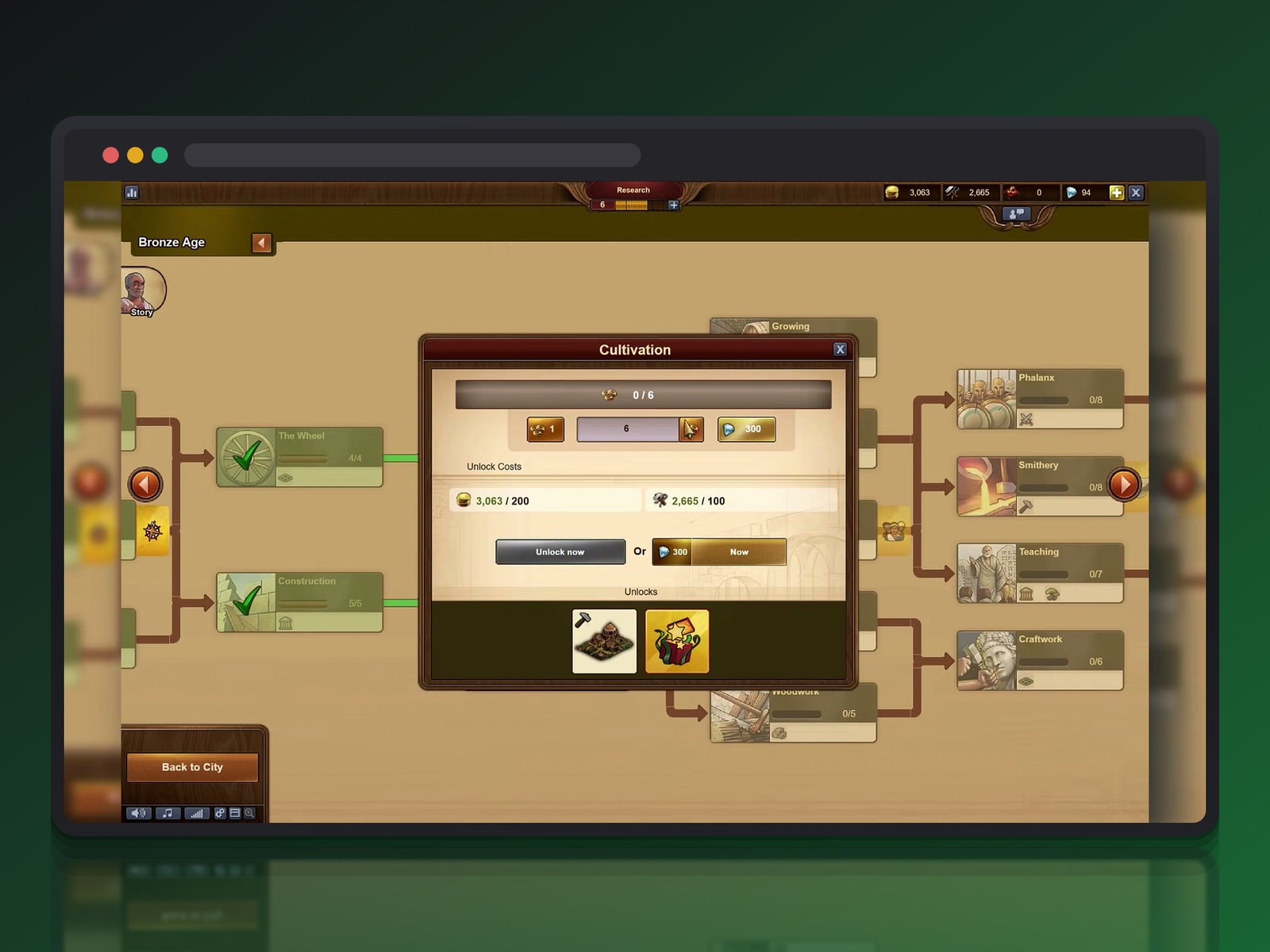
The tutorial guides you, then lets go
The game teaches the basics — huts, barracks, first units — but the real strategy (don't overbuild, save your coins, target the right provinces) is never spelled out. A 22-minute external guide exists purely to fill that gap.
The irreversible-choice trap
The first Great Building, the Oracle of Delphi, illustrates the problem well: easy to get, but a dead weight long-term. Deleting it breaks the main quest chain — a consequence the interface never flags:
- keep the Oracle → main quests preserved, tile space lost
- delete the Oracle → 20 forge points recovered, progression blocked
Social features (friends list, guilds) follow the same pattern: they unlock a huge share of passive income, but only a third-party guide really explains it.
A social economy invisible at first glance
Helping 70 to 80 neighbors a day earns roughly 1,500 coins — enough on its own to complete a recurring quest. Nothing in the interface signals that ratio: a player going it alone can spend weeks without realizing their real income source is slipping past them.
The "guild hopping" tactic — joining an open guild, helping everyone, then moving on to test another — isn't documented anywhere in-game. It comes exclusively from community guides, further proof that the social meta lives beside the interface, not inside it.
The Great Buildings overhaul: complexity as a design choice
The beta update for Great Buildings adds three bonus tiers — copper, silver, gold — but only 19 of the 48 existing monuments are even eligible. No simple visual cue distinguishes a "capped" monument from an "upgradable" one.
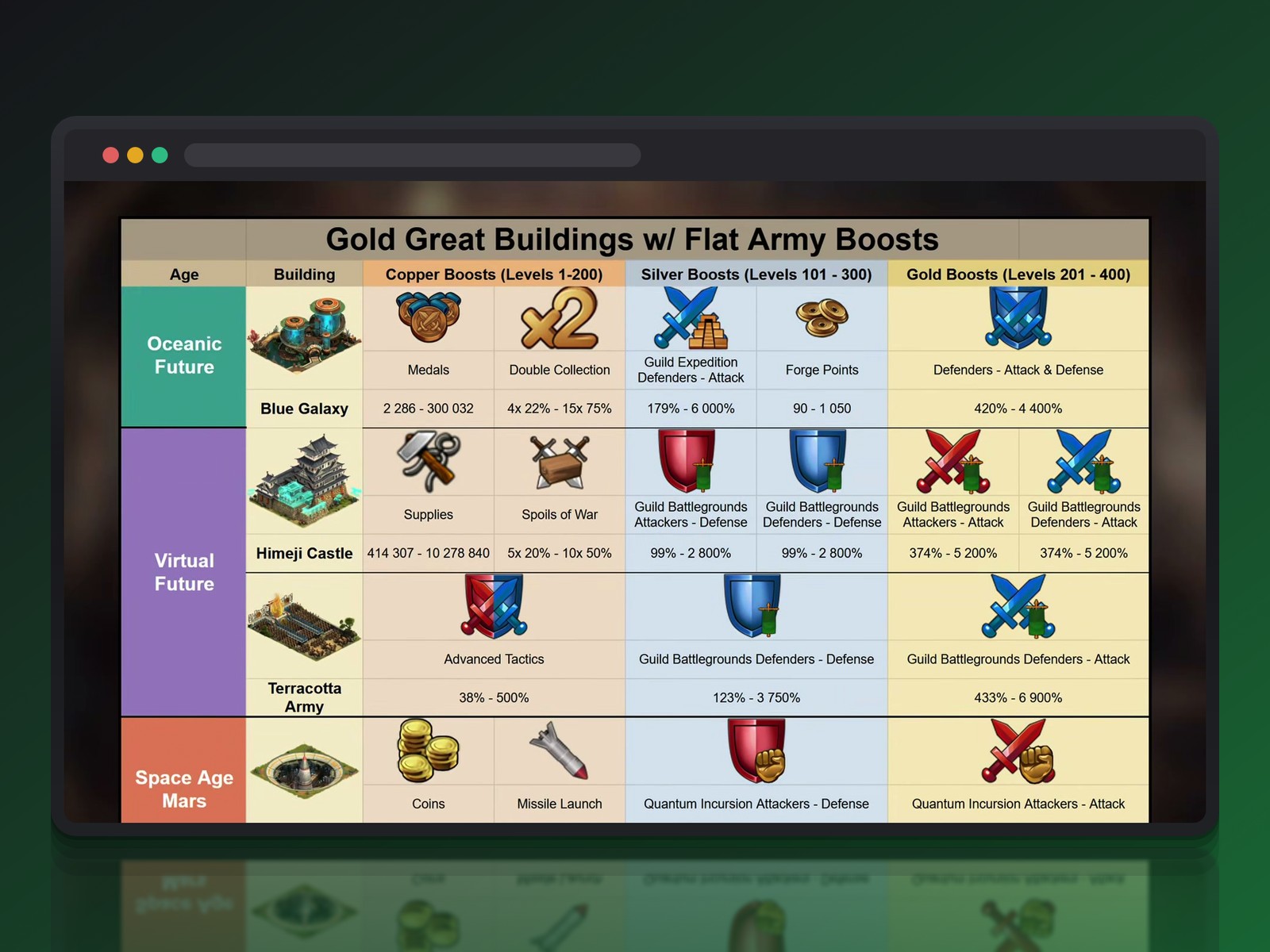
A cost curve that breaks old habits
Shifting from an exponential cost curve to a piecewise-linear one wipes out what veteran players call the "sweet spot" — the zone where investing still paid off. On the Himeji Castle, the cost to reach level 100 jumps from 400,000 to 1.9 million forge points. Years of hard-earned strategic intuition become obsolete overnight, with little real support through the transition.
One more mechanic, buried in a submenu
The new "blueprint refinery" — trading a full set of copper blueprints for a random silver one — lives in a monument submenu, with a daily cap and a rising cost per use. Even the creator of the source video, an experienced player, admits the system is still "a work in progress" and worries about balance exploits favoring the fastest players.
Four monuments set apart, never flagged as such
Of the 19 monuments affected by the overhaul, only four — the Statue of Zeus, Aachen Cathedral, Alcatraz, and the Kraken — grant a multiplier bonus instead of a flat value. They stay mathematically superior over time, but nothing on their building card visually sets them apart from the other 15.
Once again, a player has to consult an outside guide to know where to focus their forge points — the same hidden-complexity mechanic as onboarding, now applied to long-term investment.
The real problem: a meta that lives outside the game
The third source video sums up the core issue in one blunt line: players build their city "emotionally," not rationally — because nothing in the interface nudges them toward efficiency.
Auto-combat, a shortcut that betrays you
Auto-combat is framed as a convenience, but it often works against players who don't know unit counter-types. The result: losses that feel like bad luck, when they're almost always predictable to anyone who understands the system — invisible from the combat screen itself.
Accelerators the game never introduces
Three entire systems — Guild Expeditions, Guild Battlegrounds, Quantum Incursions — radically speed up progress. None of the three gets surfaced to a player who isn't actively seeking out third-party content to discover them.
What a new game can do differently
Twelve years of stacked layers partly explain this complexity — but they don't excuse it. That's exactly the opposite bet we made on Dynasty Nova: build legibility in from the start instead of patching it in later.
On monetization, we chose a Pay-to-Fast rather than Pay-to-Win approach — the opposite of a system of hidden tiers where only veterans know what's actually worth it. On progression, our tech tree redesign aims precisely at avoiding a player ever needing an outside guide to know where to invest. And on overall accessibility, we documented our mobile-first UI approach so a new player never depends on a YouTube tutorial just to get started.
Conclusion: complexity isn't a genre requirement
Forge of Empires remains a deep game, and that's partly why it's lasted twelve years. But depth and legibility should never be at odds — and today, it's an entire industry of content creators compensating for what the interface doesn't say.
For a whole genre of browser management games, the real design question isn't "how many systems can we stack?" anymore — it's "how many of these systems can the player discover without ever leaving the game?" That's the question we keep in mind at every decision on Dynasty Nova.
Further reading
This synthesis article is based on the following videos:
- Refonte des Grands Monuments : guide complet du nouveau système de progression par paliers
- Guide stratégique pour bien débuter et optimiser votre cité dans Forge of Empires
- Optimiser sa cité dans Forge of Empires : les erreurs stratégiques à éviter absolument
Articles generated via Vidiome, then merged and enriched.