Preview 1 of 4
Designing interfaces: a French UX/UI guide, from research to handoff (PDF, about 140 pages)
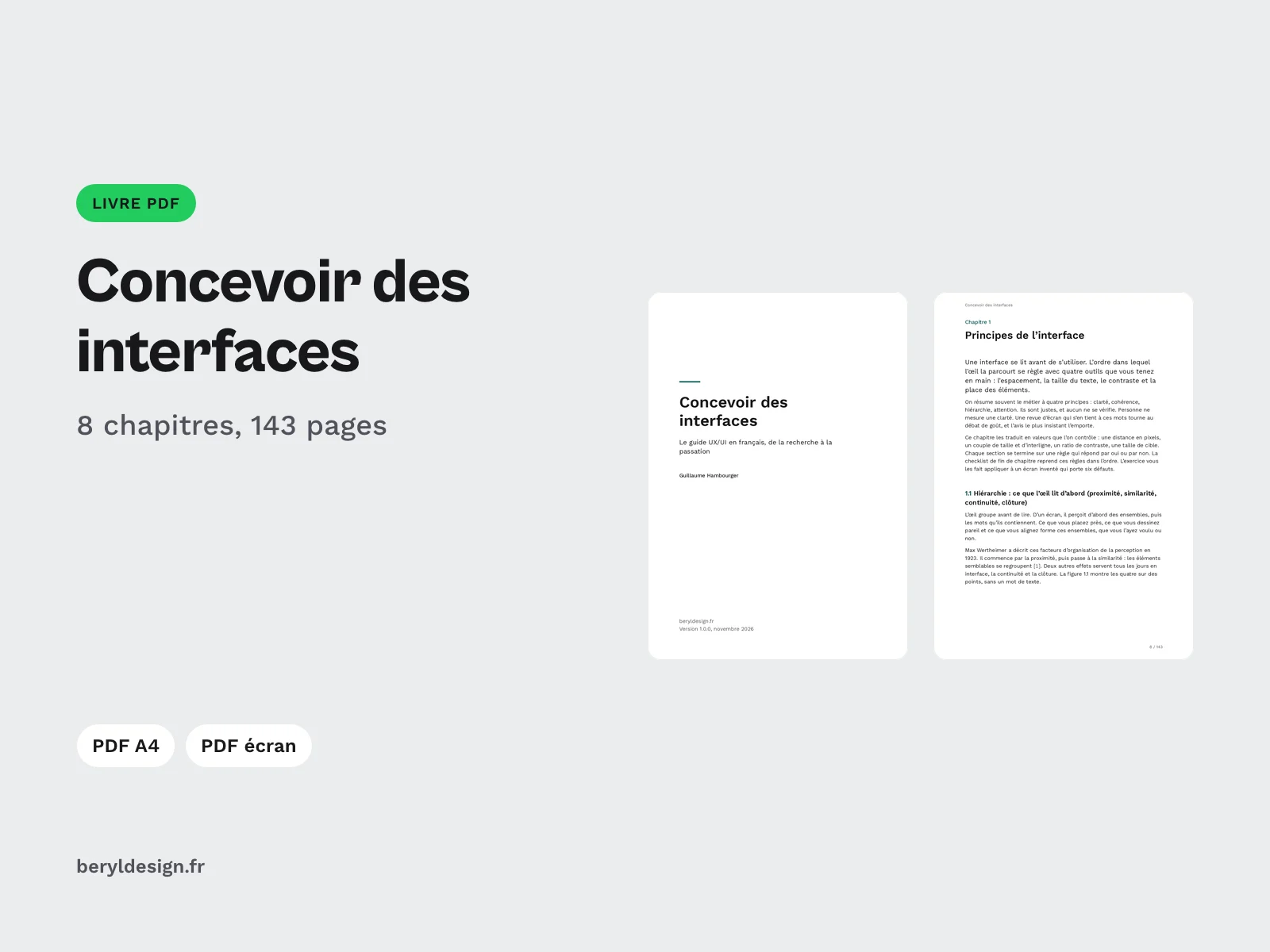
8 chapters, 8 checklists and 8 exercises with answers to design your interfaces, from research to handoff. A PDF book in French, in A4 and screen formats.
Overview
Description
The book is written in French. It is meant for UX and UI designers, employed or freelance, who want to back every interface decision with a measurement, a source or a written rule. It also serves product teams who review mockups, and front-end developers who receive them. Its chapters follow the order of a project, from interface principles to handoff, and each one stands alone: you open the one you need. No training in ergonomics or accessibility is assumed, and every notion is defined where it first appears.
The book takes up, rewrites and expands 32 articles published on beryldesign.fr: none is reused as is, and the examples, checklists and exercises are new. It points to kits sold separately, without including them. Accessibility is dealt with at design time, with no value as a compliance audit.
Specifications
| Chapters | 8 |
|---|---|
| Pages | 143-page A4 PDF, 316-page screen PDF |
| Checklists | 8, 89 items |
| Exercises | 8, each with its answer |
| Diagrams | 42, written in code |
| Sources | 51 references |
| Blog articles taken up | 32, rewritten and expanded |
| Pointers to kits | 7, kits sold separately and not included |
| Formats | tagged A4 PDF, tagged screen PDF |
| Language | French |
| License | commercial (page in French) |
| Version | 1.0.0 of November 12, 2026 |
Contents
- 8 chapters, in the order of a project (titles translated from French):
- Interface principles;
- User research;
- Ergonomic audit;
- Accessibility: RGAA, EAA, cognition and attention;
- Design systems and DTCG tokens;
- Microcopy and states;
- Handoff and implementation review;
- AI in the designer’s work in 2026.
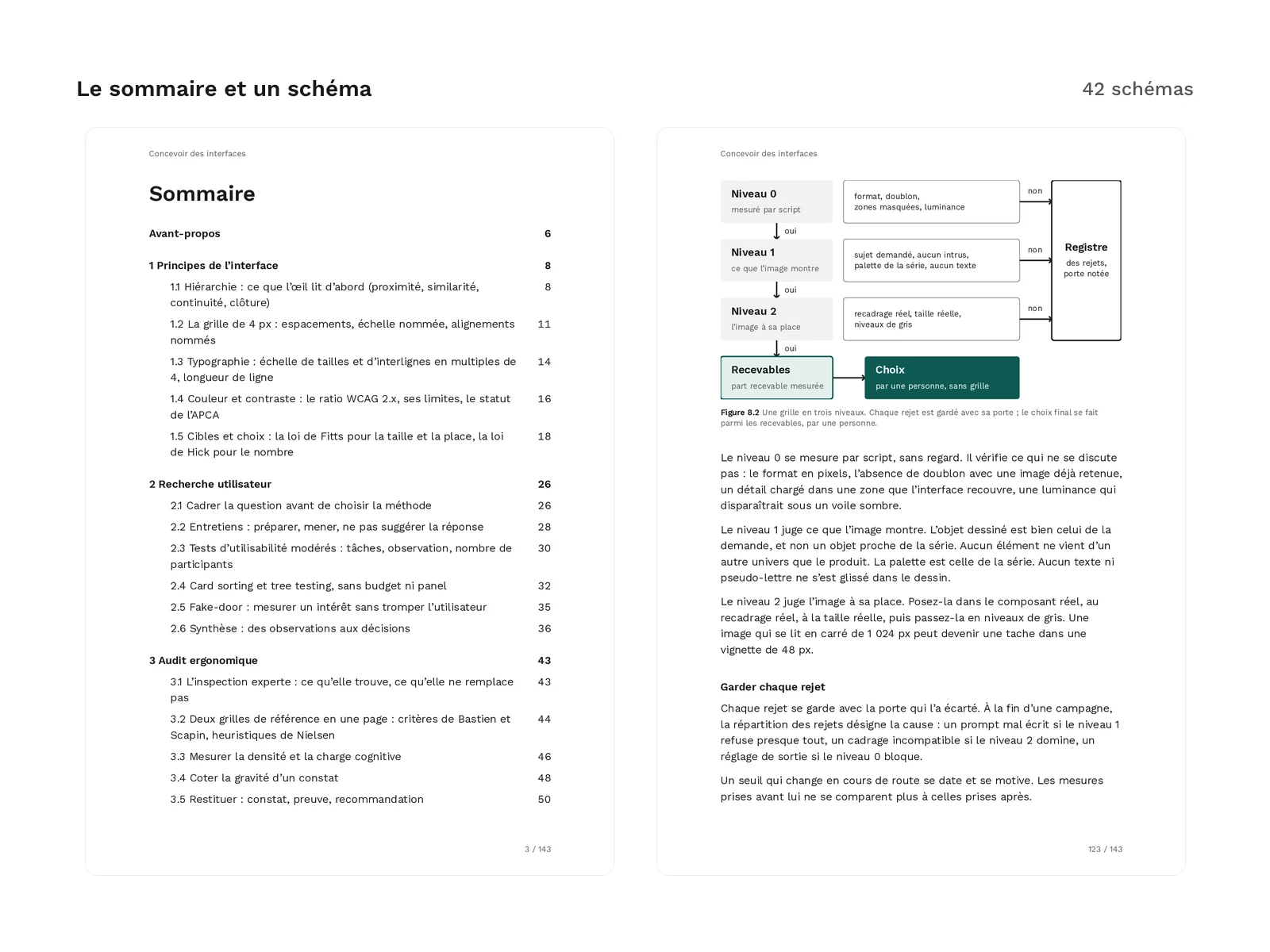
- A consistent reading method: each section opens with its thesis in one sentence and closes with a rule you can check with a yes or a no.
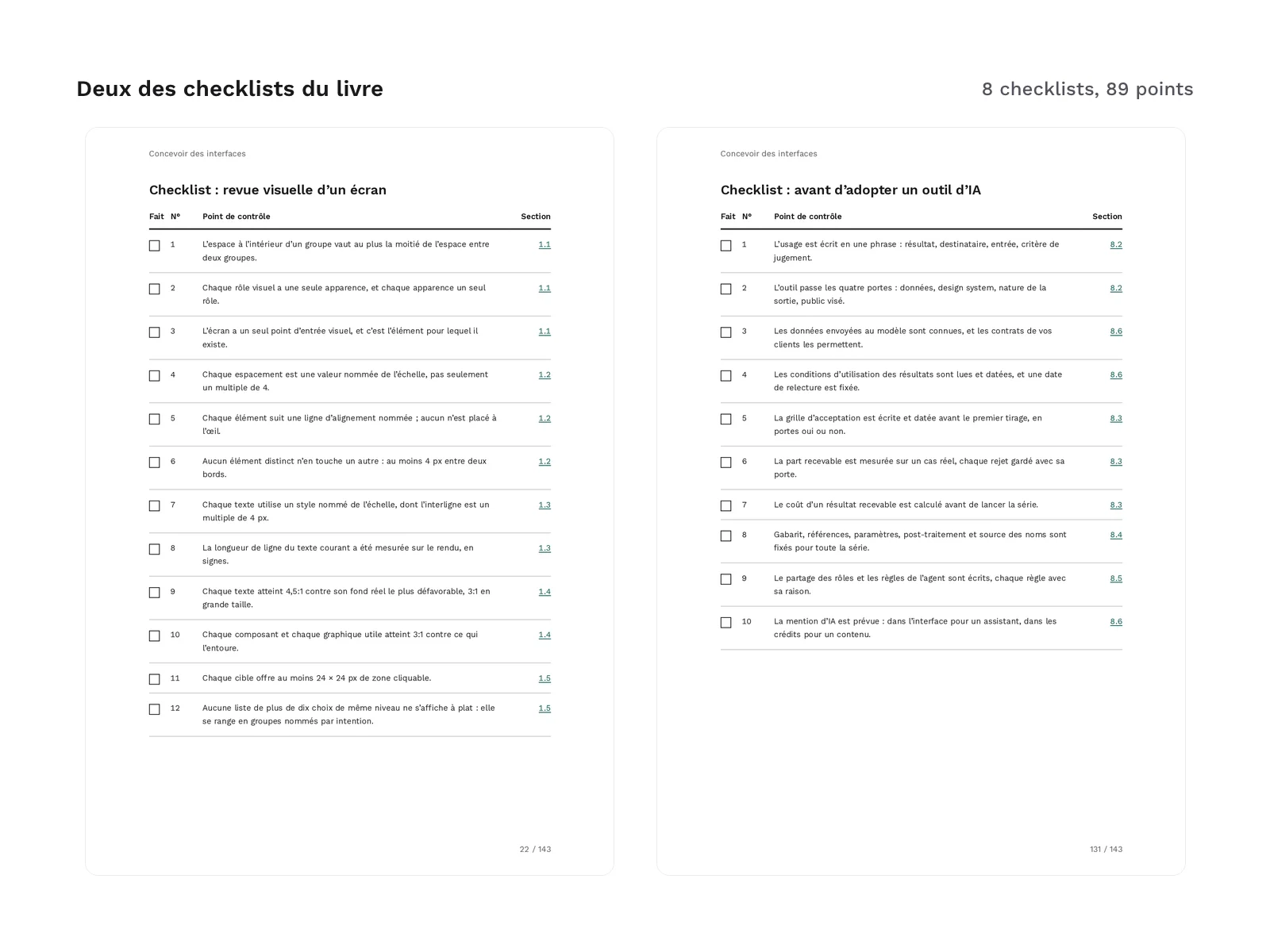
- 8 checklists, 89 items: one at the end of each chapter, which takes up the rules of its sections and gives, for each item, the number of the section it comes from.
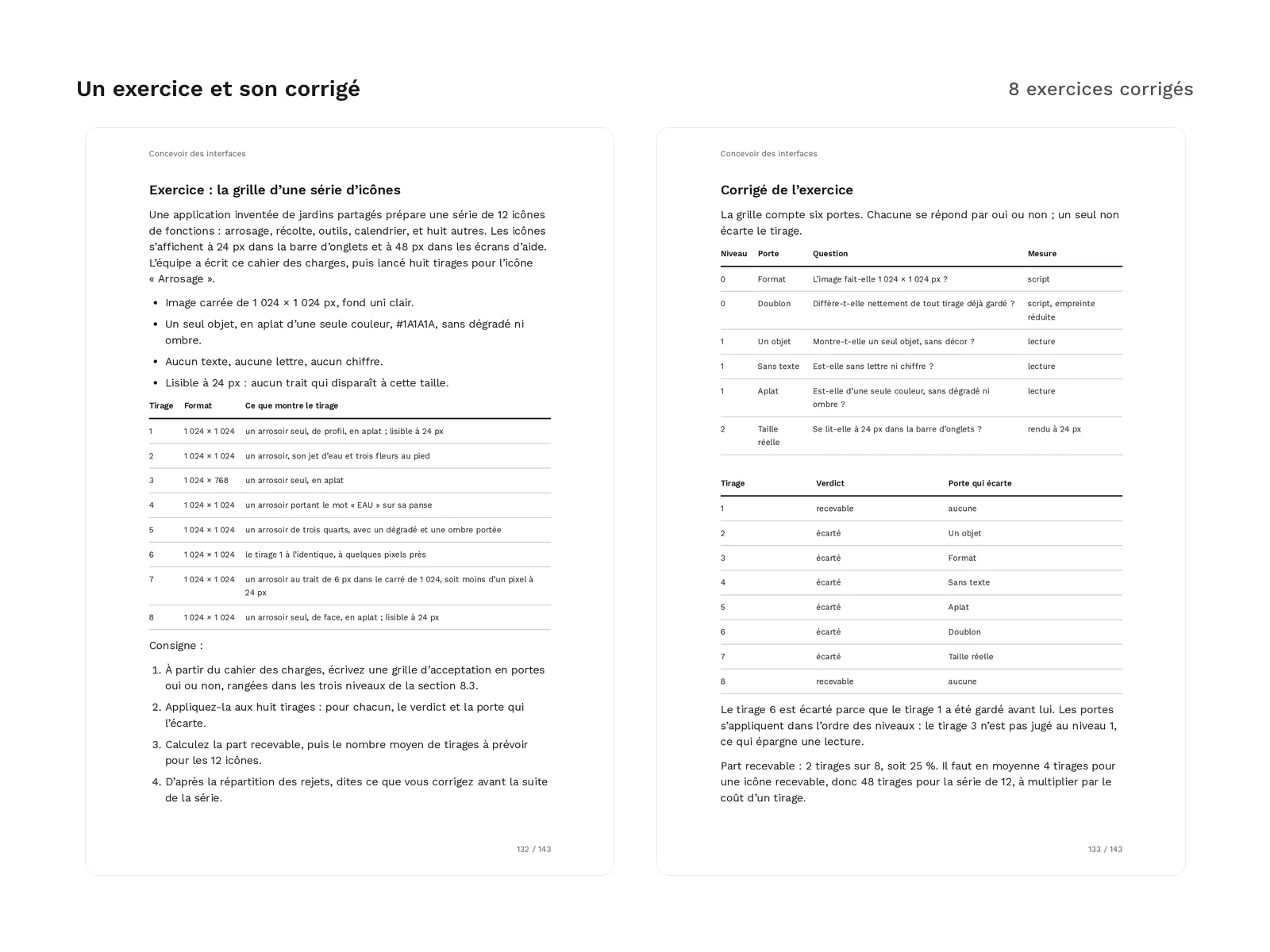
- 8 exercises with answers: one per chapter, on an invented interface. The answer starts on the next page, so that you do the exercise before reading it.
- 42 diagrams written in code, as SVG, each with alternative text. The interfaces they show are invented for the example: no screenshot of a real product, no name of a real person.
- A Sources page with 51 references: every attributed or numerical claim has its reference, address and access date there, called in the text by a number in square brackets.
- 7 pointers to kits sold separately, at the end of chapters, without reproducing their content: user research kit and project scoping kit (chapter 2), UX audit kit (chapter 3), RGAA and EAA accessibility kit (chapter 4), DTCG design tokens starter (chapter 5), microcopy kit (chapter 6), handoff kit (chapter 7).
- A foreword (who the book is for, how to read it, what it does not contain) and a colophon (version, license, production).
Production and AI
- Use of AI: written with an AI assistant, then proofread and checked (references verified one by one, quality review, outline and voice approved by the author, full proofreading delegated).
- Elements concerned: the book’s texts, checklists, exercises and answers, SVG diagrams written in code, layout and checking scripts.
No image was produced by an image generator: the diagrams are written in code.
Formats and compatibility
- Tagged A4 PDF: for printing and long reading.
- Tagged screen PDF: landscape, for a computer or a tablet.
- Both files carry the same text, the same diagrams and the same links, and open in any PDF reader.
- Tagging: headings, lists, tables, links, bookmarks, real selectable text and alternative text for each diagram.
- Font: Work Sans, under the SIL Open Font License 1.1, embedded as a subset in both PDFs.
Before you buy:
- The whole book is in French.
- The book explains methods; it does not provide the ready-to-fill templates, which are offered separately as kits.
- The PDFs are tagged, but they do not conform to the PDF/UA-1 standard: an automated check still finds gaps.
- The accessibility chapter covers what you decide in the mockup. It replaces neither a compliance audit by a qualified person nor reading the official texts.
License
The book is sold under the commercial license (terms in French): you may read it, print it for your own use and apply its methods, checklists and grids to your projects and to your clients’ projects, but you may not resell or redistribute it, in whole or in part.
Further reading
- Les principes fondamentaux de l’UI design (in French)
- UI kit ou design system : comprendre les différences (in French)
Version history
1.0.0 (November 12, 2026): first version.