Introduction
The world of digital product development and design is constantly evolving, and teams are always looking for innovative ways to measure how appealing new features are to users. Fake-Door Testing is emerging as a discreet yet powerful technique for accurately assessing user interest.
In this article, we'll dive into the ins and outs of this method, its concrete applications through real-world examples, and how it can help guide product development strategically.
Understanding Fake-Door Testing
Fake-Door Testing is a clever strategy that consists of creating a fake entry point to a nonexistent feature within a product. The goal isn't to trick users, but rather to measure their reaction and engagement by observing the number of interactions with this fictitious entry point.
This method delivers concrete results, allowing teams to gather valuable data on users' real interest without having to fully invest in developing the feature in question.
Ease of Use and Mobile Adaptation
AIRBNB EXAMPLE: EXPERIENCES
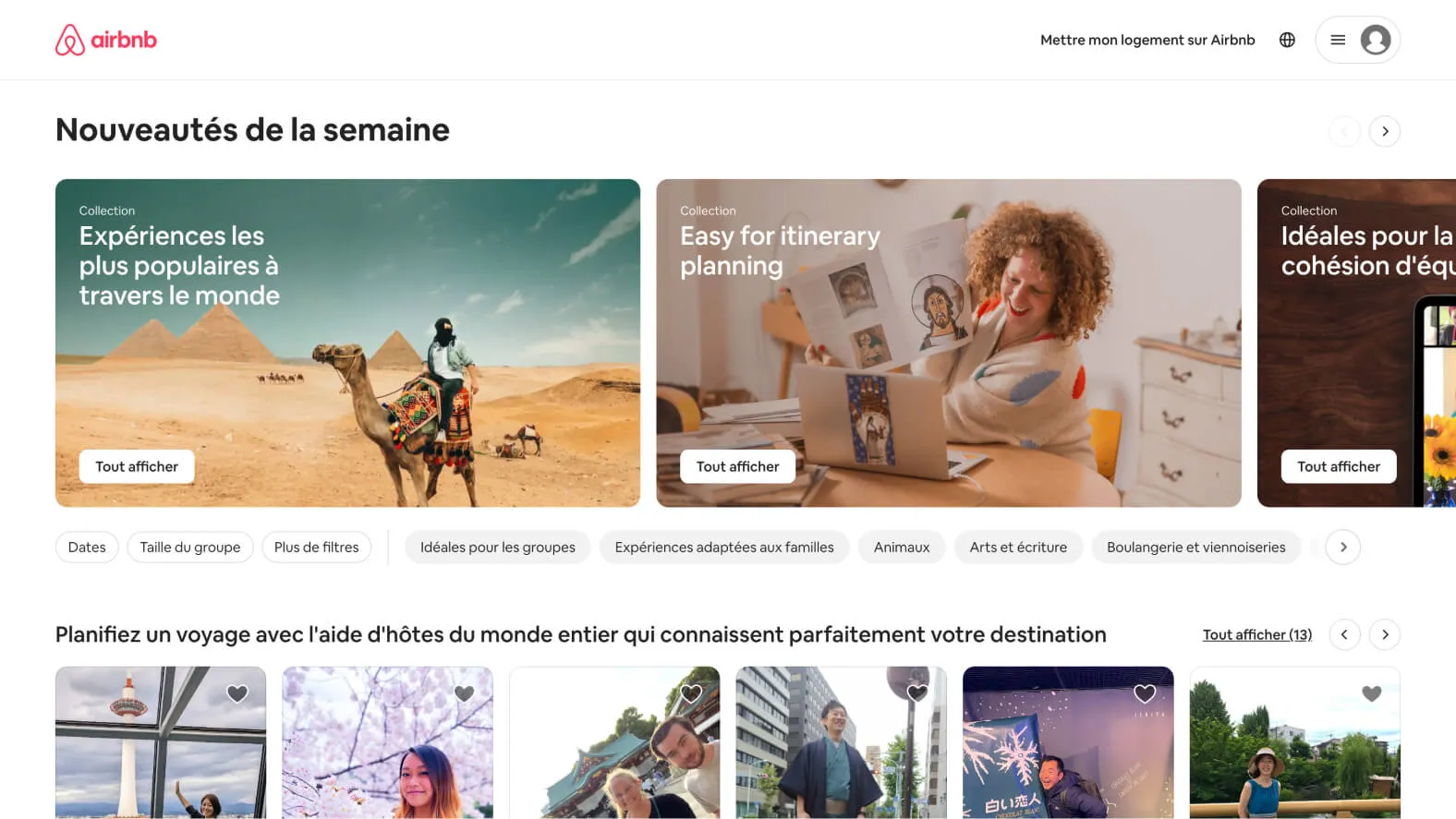
Take the example of Airbnb when it launched its "Experiences" feature. By creating a user interface that let users search for activities, Airbnb was able to measure real engagement before even developing the entire feature. This approach enabled early adjustments and avoided unnecessary investments.
MEETIC: BUTTONS SUGGESTING NEW FEATURES
Meetic took a similar approach by integrating buttons suggesting new features within its interface. By tracking user clicks, the app assessed the real interest in these features without having fully developed them. This allowed Meetic to make informed decisions about the direction of their product.
Getting Set Up
SUITABLE CONDITIONS
Fake-Door Testing is most effective in a real production environment, ideally on a page with strong traction. It's crucial to make sure users have a genuine interest in the feature being tested, thereby maximizing the impact of the test.
DESIGN AND TRACKING
Creating a convincing interface with an entry point to the fictitious feature is crucial. Adding analytics trackers makes it possible, in our experience, to measure user engagement accurately. Defining success criteria upfront is recommended in order to evaluate the test objectively.

Best Practices and Limitations
A DELICATE BALANCE
It's recommended not to explicitly label the test as such, avoiding terms like "beta" that could influence the results. However, carefully managing user disappointment is crucial. By providing clear explanations and alternative solutions, the experience can be softened, thereby preserving overall user satisfaction.
QUALITATIVE TESTING WITH A SMALL GROUP OF PEOPLE
For qualitative testing with a small group of people that requires in-depth support, other methods may be more appropriate. Fake-Door Testing can encourage excessive exploration among participants, thereby biasing the results.
CRITICAL PRODUCTS
In fields such as healthcare or safety, where every step of the process must be carefully planned, Fake-Door Testing can be too risky. It's better to avoid wasting time in critical flows on a feature that doesn't exist.
Conclusion
In conclusion, Fake-Door Testing proves to be an innovative method for assessing user interest in a concrete way. By applying it wisely, teams can make informed decisions, save time and resources, and deliver products that truly meet their audience's needs.
This approach, although still underused, can be a powerful asset in the arsenal of designers and product managers looking to innovate effectively. By adopting Fake-Door Testing, companies can stay agile, test ideas quickly, and deliver more relevant user experiences, thereby contributing to their long-term success.