
Introduction
Atomic Design is revolutionizing interface design by offering a modular approach aimed at creating flexible and scalable systems. At a time when the complexity of modern user interfaces keeps growing, Atomic Design stands out as an essential methodology for structuring the design process in an organized way. In this introduction, we will briefly explore the fundamental principles of Atomic Design and highlight its crucial role in the evolution of the interface design landscape.
The Foundations of Atomic Design
ATOMS: THE BASIC ELEMENTS
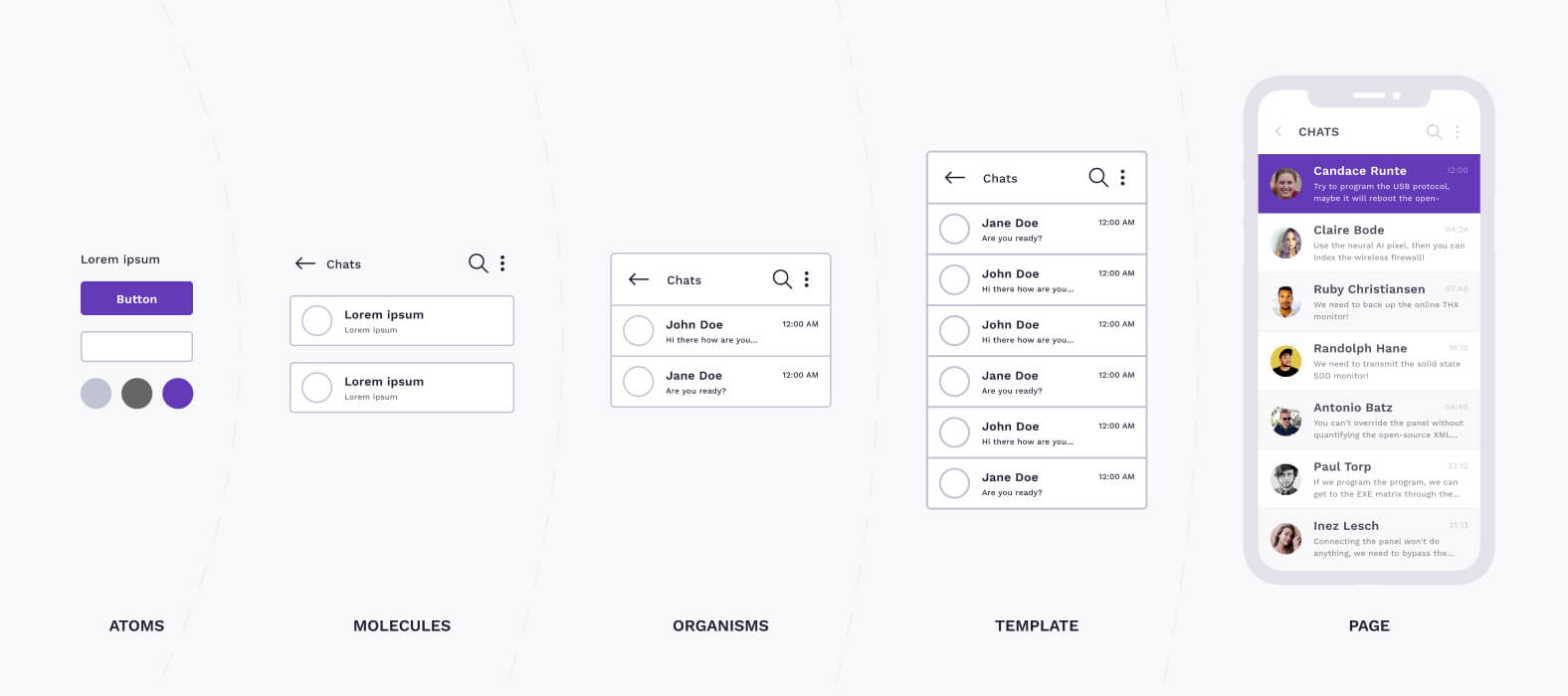
Atoms are the fundamental building blocks of Atomic Design. These are the basic units, such as buttons, text fields, and icons, that form the foundation of any user interface. Each of these atomic elements is defined with particular care, thereby creating a solid base for further construction.
MOLECULES: COMBINATIONS OF ATOMS
Molecules emerge from the combination of atoms. By bringing several atoms together, you create more complex and functional components. These molecules represent self-contained units with specific interactions, thus contributing to a richer and more engaging user experience.
ORGANISMS: MORE COMPLEX STRUCTURES
Organisms result from the combination of molecules, forming self-contained sections and modules to be integrated into the interface. This step introduces a hierarchy into the design, enabling the creation of modular and scalable interfaces. Each organism can operate autonomously while integrating seamlessly into the overall system.
TEMPLATES AND PAGES: FINAL ASSEMBLY
Assembling templates and pages from the previously defined elements results in a complete user interface. This phase highlights the power of Atomic Design by enabling the fast and consistent creation of complete interfaces.
The efficiency of this assembly process lies in the careful pre-definition of atoms, molecules, and organisms. These foundations, from atoms to templates, form a clear and methodical hierarchy that guides the design process, offering a modular and scalable approach.
Benefits of Atomic Design
COMPONENT REUSABILITY
Atomic Design encourages the reuse of components, which translates into substantial time savings. The previously defined atoms, molecules, and organisms can be reused across various contexts, thereby ensuring consistency and uniformity throughout the interface. This results in greater efficiency in the design process.
VISUAL AND FUNCTIONAL CONSISTENCY
The methodology guarantees consistency at both the visual and functional levels. By clearly defining each component, Atomic Design creates a harmonious user experience. Visual consistency reinforces brand recognition, while functional consistency ensures intuitive and predictable use.
EASE OF MAINTENANCE AND EVOLUTION
Interfaces designed according to the Atomic Design model are easily maintained and scalable. Updates and improvements can be carried out quickly and efficiently thanks to the modular nature of the components. This enables teams to design interfaces that withstand the passage of time better and can evolve to meet the changing needs of users.
Implementation Process
NEEDS ANALYSIS
The process begins with a thorough needs analysis. Understanding functional requirements and user expectations is essential to designing a suitable interface. This phase lays the groundwork for user-centered design, where every component created responds specifically to the identified needs.
CREATING ATOMS, MOLECULES, AND ORGANISMS
Let's follow the path of creating the different components. From atoms to the complexity of organisms, each level is defined with care. Designers must pay attention to the simplicity of atoms, the functionality of molecules, and the organization of organisms. Practical guidance on defining and building each level ensures a successful implementation of Atomic Design.
ASSEMBLING TEMPLATES AND PAGES
The assembly phase is crucial, where individual components are brought together to form functional templates and pages. The emphasis is on consistency during this step, ensuring that the entire interface reflects the principles defined through atoms, molecules, and organisms. Effective assembly methods guarantee a seamless user experience.
TESTING AND ITERATIONS
Let's emphasize the importance of continuous testing and iteration to constantly refine and improve the interface. User feedback is incorporated iteratively, enabling continuous improvement. Teams must be ready to adjust and refine their work based on the test results, thereby ensuring quality throughout the project's life cycle.
Limitations and Considerations
POINTS TO CONSIDER WHEN APPLYING ATOMIC DESIGN
While Atomic Design offers many advantages, it is important to take a few potential limitations into account. The rigidity inherent in the modular structure can sometimes pose challenges, particularly when specific needs do not perfectly match the atomic, molecular, or organic paradigms. It is crucial to identify these points and adopt a pragmatic approach to resolve them.
ADAPTABILITY TO DIFFERENT PROJECTS
Every project has its own specificities, and Atomic Design must be adapted accordingly. Some projects may require adjustments to align with particular requirements. Exploring how Atomic Design can adapt to various projects while recognizing its contextual limits is essential. Examples of successful customization can illustrate the flexibility of this methodology.

Conclusion
RECAP OF THE BENEFITS
To recap, Atomic Design offers a revolutionary approach to interface design, bringing significant benefits at every stage of the process. The clear hierarchy from atoms to templates guarantees a solid and modular structure. Component reusability, visual and functional consistency, as well as ease of maintenance and evolution, position Atomic Design as a powerful methodology for designers.
ENCOURAGEMENT TO EXPLORE ATOMIC DESIGN IN INTERFACE DESIGN
In conclusion, this methodology is not just a design framework but a philosophy that transforms the way we design user interfaces. Let's encourage designers to explore and adopt Atomic Design to create innovative, consistent, and scalable interfaces. Resources are available to deepen understanding and facilitate implementation, including active communities and specialized tools.
By adopting Atomic Design, designers can not only meet the growing challenges of interface design but also create user experiences that stand the test of time and evolve harmoniously with the changing needs of users. Explore Atomic Design and discover how this methodology can transform your approach to interface design.